
Is expensive perfume worth it? Sometimes—but the price tag is not the test. A good perfume earns its place when you enjoy the full dry-down, it performs appropriately for your routine, and you wear it often enough for the cost to make sense. An expensive bottle that stays in a drawer is poor value; a carefully chosen fragrance worn every week can be excellent value.
This practical New Zealand guide explains what “good perfume” should mean, five reasons quality fragrance can justify a higher price, how to calculate cost per wear and when you should keep your money. It also replaces the old idea that every premium perfume is automatically stronger, longer-lasting or made only from “better” ingredients.
Quick answer: A good perfume is worth it when you love the scent after several hours, can wear it in real situations, trust the product and retailer, and the cost per wear fits your budget. Do not pay more only for a logo, a concentration label or a promise of compliments.
Are Expensive Perfumes Really Better?
Not automatically. Price can reflect creative work, formula development, materials, packaging, marketing, distribution, brand positioning and production scale. Some of those things improve the wearing experience; others may matter less to you. A lower-priced fragrance can be beautifully composed, and an expensive one can still feel wrong on your skin or unsuitable for your lifestyle.
Performance is not a reliable price meter either. Longevity and projection depend on the complete formula, the materials used, the amount applied, your skin, temperature, airflow and what you consider noticeable. An Eau de Parfum may feel fuller than an Eau de Toilette, but the letters on the box do not promise an exact number of hours.
The useful comparison is therefore not simply cheap versus expensive. It is price versus personal value. Ask what the fragrance gives you, how often you will use it and whether a less costly option satisfies you just as well.
What Makes a Perfume “Good”?
A good perfume should smell intentional from the opening to the dry-down. The notes do not need to be natural, rare or powerful. Modern perfumery uses both natural extracts and aroma materials; craftsmanship is about how those materials are selected, balanced and made to work together.
Use these five checks:
- Balance: no single part feels accidentally sharp, muddy or disconnected.
- Development: you enjoy the heart and base, not only the first bright spray.
- Wearability: the strength and style fit the places where you plan to use it.
- Consistency: you are buying an authentic product from a retailer you can identify and contact.
- Personal fit: you want to wear it again without needing approval from a trend list or another person.

5 Reasons a Good Perfume Can Be Worth It
1. You Are Paying for the Complete Wearing Experience
The first spray is only the introduction. A well-chosen fragrance continues to feel satisfying as the brighter opening gives way to the heart and base. That development can create contrast, texture and a recognisable character rather than one flat impression.
This is where a slow skin test matters. If you love a perfume at ten minutes but dislike it at two hours, its reputation and price cannot make it a good purchase. If you enjoy every stage and keep returning to your wrist, the fragrance is delivering something meaningful to you.
Quality is also not the same as loudness. A soft fragrance can be beautifully constructed; a strong fragrance can be tiring. Judge how complete and comfortable it feels, not how far it travels across a room.
2. Frequent Wear Can Create Better Cost per Wear
A bottle price tells you what you pay today. Cost per wear tells you what the purchase costs in your real life.
Cost per wear formula
Bottle price ÷ number of times you actually wear it = cost per wear
For example, a NZ$240 fragrance worn 240 times costs NZ$1 per wear. A NZ$90 blind buy worn only six times costs NZ$15 per wear. These are illustrations, not promises about how many sprays or years a bottle will provide: bottle size, atomiser output and your spray routine all vary.
Estimate honestly. Think about how often you wear perfume now, not how often you imagine you might. If you expect to use a fragrance twice a week for a year, base the decision on roughly 100 wears and then decide whether that result feels reasonable.
A smaller bottle or perfume sample can be the better-value purchase when you are still testing. Buying less of the right scent is usually smarter than buying more of the wrong one.

3. The Right Performance Can Reduce Reapplication and Regret
Performance matters when it matches the job. You may want an office fragrance that stays close, an evening scent with more presence or a versatile perfume that moves comfortably from day to dinner. The “best” performance is not always the longest or strongest; it is the level that works without becoming distracting.
Test longevity and projection separately. A fragrance can remain on skin for hours while projecting softly, or open loudly and become quiet much sooner. Check it after 30 minutes, two hours and near the end of your normal wearing day. Ask someone you trust only if you want a second view—your own comfort is still the deciding factor.
If you are comparing EDT, EDP and Parfum, use our perfume concentration guide. Different versions can have different balances, so choose the smell and performance you prefer rather than assuming the most concentrated option is automatically the best value.
4. One Useful Fragrance Can Cover More of Your Life
Versatility can make a good perfume more valuable. A scent that feels polished at work, comfortable at lunch and appropriate for dinner has more opportunities to earn its cost than a bottle reserved for an imaginary occasion.
Think in roles:
- Day: comfortable, easy to control and pleasant in close spaces.
- Work: polished without dominating a meeting, shop floor or shared office.
- Evening: enough depth or presence to feel intentional after dark.
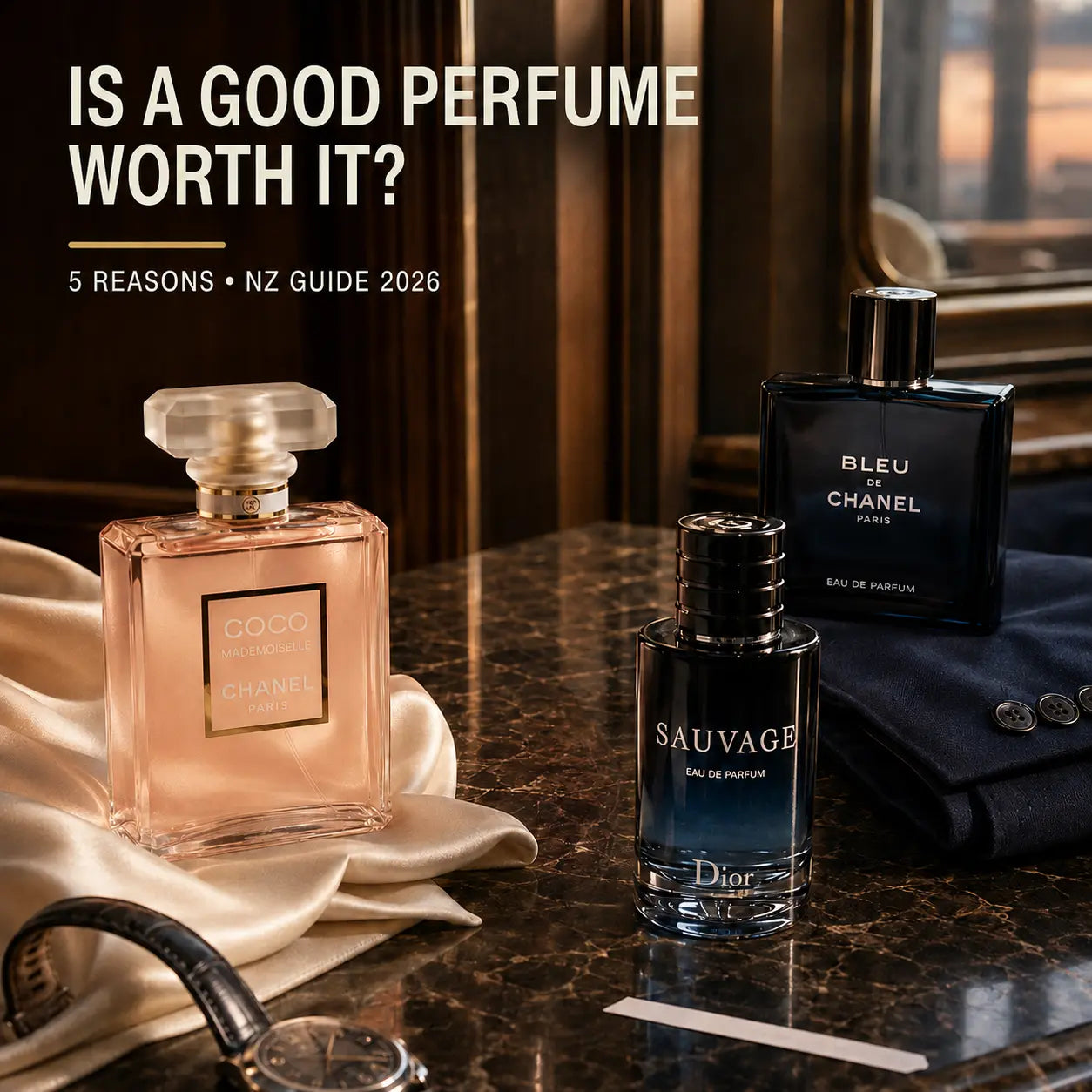
For example, Chanel Coco Mademoiselle EDP moves from bright orange into jasmine, rose, patchouli and vetiver; Bleu de Chanel EDP offers an aromatic-woody profile with ambery, musky and sandalwood character; and Dior Sauvage EDP contrasts bergamot with warm vanilla and woods. They are different directions, not a ranking. Your role is to decide which style fits the moments you actually have.

5. Personal Enjoyment Has Real Value
Perfume is worn close to you for hours, so pleasure and confidence are legitimate parts of the value calculation. A fragrance can become a finishing detail before work, a way to shift your mood for an evening or a scent connected with an important period of life.
That does not mean perfume guarantees confidence, attraction or compliments. It means a scent you genuinely enjoy can support the way you want to present yourself. The strongest sign is simple: you reach for it willingly and still like it when nobody comments.
If you want help finding that personal fit, use our separate seven-step signature scent guide. This article decides whether a fragrance deserves your budget; that guide helps decide which scent feels most like you.

When Is an Expensive Perfume Not Worth It?
Keep your money—or choose a sample or smaller bottle—when any of these are true:
- You like the opening but not the dry-down.
- You are buying mainly because the bottle is trending.
- The price would make you afraid to use it.
- You already own a fragrance that does the same job and prefer it.
- You need to overspray or repeatedly reapply to enjoy it.
- You have not tested it and the retailer does not offer a suitable sample.
- The seller, authenticity information, returns process or contact details are unclear.
A beautiful perfume can still be the wrong purchase today. Waiting, sampling or selecting a more affordable fragrance is not “settling”; it is making the value decision properly.
How to Test a Good Perfume Before Buying
- Start with two or three blotters. Label each one and remove any option you clearly dislike after 10–15 minutes.
- Put the finalists on skin. Test one on each arm or, ideally, wear them on separate days.
- Wait for the dry-down. Recheck after roughly 30 minutes, two hours and later in the day.
- Use your normal setting. A work scent should be tested around work; an evening scent should survive an actual evening.
- Check the value. Name at least three occasions when you would wear it and estimate a realistic cost per wear.
- Buy the sensible size. Choose a sample or smaller bottle when you are uncertain; choose a larger bottle only when repeat wear supports it.
New Zealand weather can change how noticeable a fragrance feels. Warm conditions may make an opening feel more immediate, while a light scent can seem quieter outdoors on a cold or windy day. Our summer and winter perfume guide explains how to adjust the profile and number of sprays without imposing rigid seasonal rules.
How to Protect the Value of Your Perfume
Store the bottle upright in a cool, dark and stable place. Keep it away from direct sunlight, heaters, hot cars and bathrooms with frequent temperature and humidity swings. Close the cap when the bottle has one, and follow the directions and precautions on the packaging.
Apply with restraint, then reassess. More sprays do not improve the formula; they only increase the dose. If you apply to clothing, check the manufacturer’s guidance and test a hidden area first because some fabrics may mark.
Where to Buy Authentic Perfume in New Zealand
Value depends on receiving the product you intended to buy. Check the retailer’s identity, New Zealand contact details, product information and support policies before ordering. Packaging details can vary by market or production update, so one visual clue alone does not prove whether a bottle is genuine.
Use our detailed authentic perfume buying guide for a practical checklist. You can also browse perfumes and fragrances at Gadgets Online NZ or visit our Mount Eden, Auckland store. Product availability changes, so check the live product page or contact the store before travelling for a specific fragrance.
Is Expensive Perfume Worth It? FAQs
Are expensive perfumes always better?
No. A higher price can reflect formula development, materials, packaging, marketing, distribution and brand positioning, but it does not guarantee that you will prefer the scent or that it will perform better on you. Test the full dry-down and compare personal value, not price alone.
Do expensive perfumes last longer?
Not necessarily. Longevity depends on the complete formula, application amount, skin, weather and environment. Some expensive fragrances are deliberately soft, while some affordable fragrances are very persistent. Test the actual product rather than using price as a performance promise.
What makes a perfume good quality?
Look for a scent that feels balanced, develops in a way you enjoy, performs appropriately for its purpose and comes from a source you trust. Natural ingredients, high concentration and strong projection are not automatic proof of quality.
How much should I spend on perfume?
Spend only what fits your discretionary budget and expected use. Work backwards from realistic wears: divide the price by the number of times you expect to wear it, then compare that cost per wear with your other options. A sample or smaller bottle is sensible when you are unsure.
How do I calculate perfume cost per wear?
Divide the bottle price by the number of times you actually expect to wear it. For example, NZ$240 divided by 240 wears equals NZ$1 per wear. Do not assume a fixed number of wears from a bottle because spray output and application habits vary.
Should I buy EDT, EDP or Parfum?
Choose the version whose scent, strength and price best fit your routine. EDP often feels fuller and EDT often feels lighter, but versions may use different note balances and concentration does not guarantee exact longevity. Test them side by side when possible.
How can I avoid regretting a perfume purchase?
Test no more than three options at once, wear the finalists on skin, wait several hours, repeat the test on another day and buy the smallest practical size if you remain uncertain. Do not judge only the opening or buy solely because a fragrance is popular.
Where can I buy authentic perfume in NZ?
Choose an identifiable retailer with clear New Zealand contact details, product information and support policies. Gadgets Online NZ has served customers since 2008 and operates online and from 591 Dominion Road, Mount Eden, Auckland. Contact the store first if you want to check a specific product’s availability.
Fragrance performance and scent perception vary with the formula, skin, application and environment. Product availability, packaging, formulation and liquid colour may change between markets or production updates. Always check the ingredient list and use directions on the product you receive.