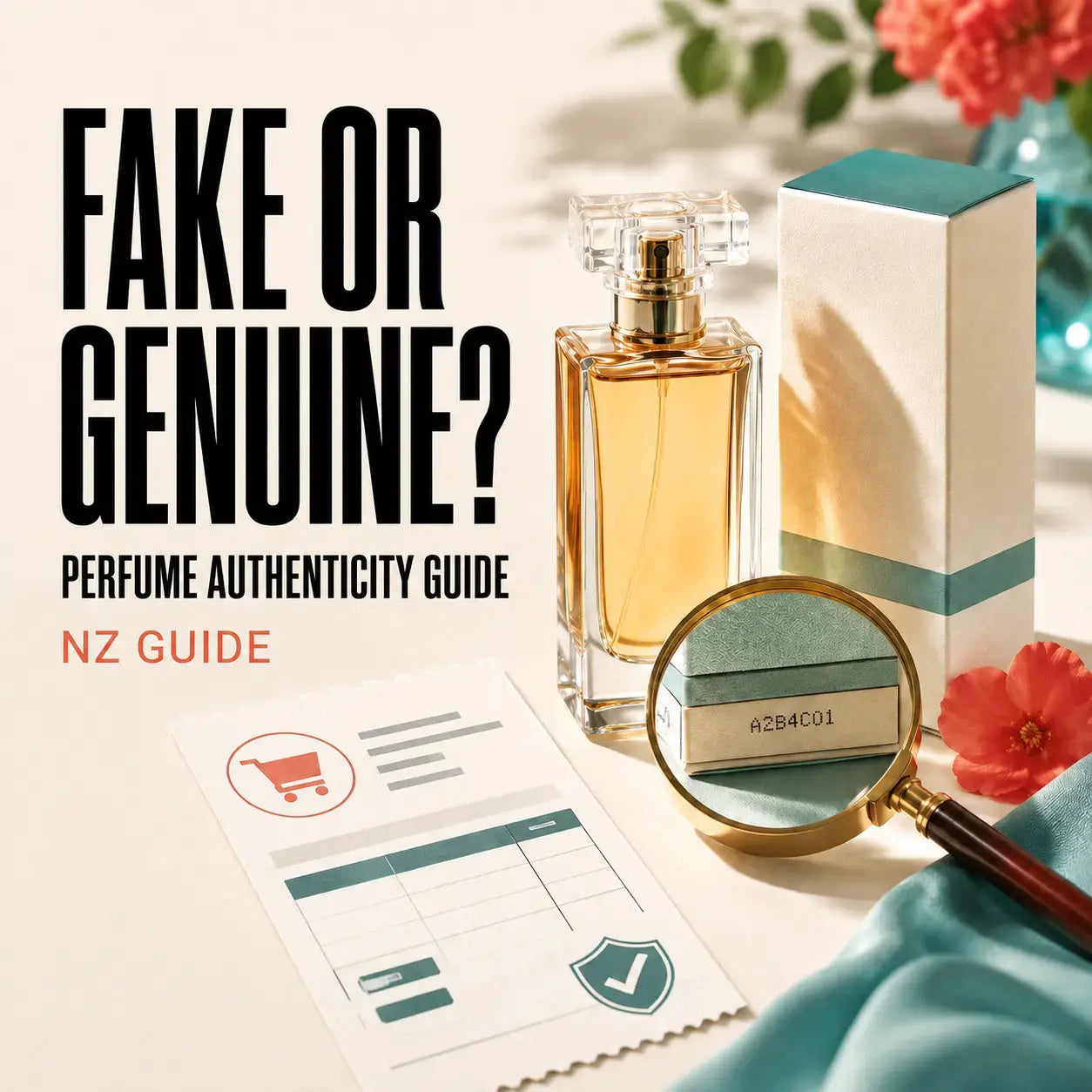
Trying to work out how to spot fake perfume in NZ? Start with the seller, then assess the packaging, bottle, batch information, price and scent together. No barcode, batch-code website or cellophane test can prove authenticity on its own.
Quick answer
A genuine perfume should make sense as a complete purchase: a traceable retailer, accurate product description, coherent packaging and bottle details, a credible price, and support if something is wrong. One odd detail is a reason to investigate—not an automatic verdict.
How to spot fake perfume in NZ: start before you open the box
Many guides begin with cellophane or a batch code. Those details can help, but they begin too late. Counterfeit packaging can imitate genuine packaging, while genuine stock can vary by market, production period, bottle size or reformulation. The strongest first check is whether the business selling the perfume is identifiable and accountable.
Before buying, look for a real trading name, New Zealand contact details, a physical address where appropriate, secure payment methods, clear delivery and returns information, and a history you can verify beyond the retailer’s own website. Read independent reviews for patterns rather than expecting every review to be perfect. A legitimate seller should explain what it is selling and respond when a customer raises a concern.
New Zealand’s Consumer Protection guidance also matters here. Products bought from a New Zealand retailer—including parallel imports—are covered by the Consumer Guarantees Act. Businesses must not mislead customers about a product’s nature, quality, origin or history under the Fair Trading Act.
Ten checks for fake perfume versus authentic perfume

1. Verify the retailer, not just the product photograph
A polished product image is easy to copy. Check who operates the website, how long the business has traded, whether contact details work, and whether its returns process is understandable. Be cautious when a seller exists only through a disposable social account, asks for payment outside a protected checkout, or pressures you to act immediately.
2. Compare the exact product, concentration and size
EDT, EDP, Parfum and Elixir versions can have different bottles, caps, box colours and scent profiles. A 50 ml bottle may not be proportioned exactly like a 100 ml bottle. Compare like with like using the brand’s official product page or a trusted retailer—not a random image-search result that may show an older release.
3. Inspect printing, alignment and product information
Look for spelling mistakes, fuzzy printing, crooked panels, unusual spacing, missing volume or concentration information, and labels that do not align with the known design. These can be warning signs. However, brands change packaging and regulatory information, and parallel-imported stock may be labelled for another genuine market. A small packaging variation needs context.
4. Assess the cellophane and seals carefully
Loose wrapping, heavy glue, uneven folds or a box that appears re-sealed can justify questions. They are not universal tests. Some genuine fragrances are not cellophane-wrapped, and testers or gift sets can use different presentation. Judge the wrapping against the exact edition you purchased.
5. Examine the bottle, cap and sprayer
Check the glass finish, mould seams, label placement, cap fit, collar, atomiser and liquid level. Poorly finished glass, a visibly tilted sprayer or a cap that bears no resemblance to the expected design may be concerning. Minor cosmetic variation can still occur, so use these details as part of the overall assessment.
6. Check whether bottle and box information agree
Where both bottle and box carry batch or production information, compare them. A clear mismatch is worth raising with the retailer. But a matching batch code is not proof by itself: codes can be copied, and third-party batch-check websites may have incomplete data. A barcode identifies product information; it is not a built-in authenticity certificate.
7. Treat the price as a clue, not a verdict
A price far below every credible seller can be a risk signal, especially when combined with vague business details or pressure tactics. Yet a genuine fragrance can cost less because of parallel importing, wholesale purchasing, promotional stock, older packaging or a clearance. “Discounted” and “counterfeit” are not synonyms.
8. Smell the full development, not only the first spray
When possible, test on a blotter and skin and allow the fragrance to develop from opening notes through the heart and dry-down. A harsh or unfamiliar scent may prompt investigation, but scent is not a laboratory test. Storage, age, reformulation, concentration, skin chemistry, temperature and even your own recent exposure to a fragrance can change what you perceive.
9. Do not use longevity as the only test
A fragrance disappearing quickly does not automatically mean it is fake. Citrus and fresh compositions may sit closer to the skin than dense amber or woody scents. Weather, dry skin, moisturiser, spray location and olfactory fatigue all affect perceived performance. Compare the same concentration under similar conditions before drawing a conclusion.
10. Judge what happens after the sale
Trustworthy retailers do not disappear when a customer asks a reasonable question. Keep the order confirmation, photograph the parcel and packaging, and contact the seller with specific details. A clear response and a fair process are stronger trust signals than a generic “100% authentic” badge placed on a website.
The safest conclusion comes from the total evidence: seller + product details + price + purchase support.
Which authenticity clues are useful—and what do they not prove?
| Check | Useful clue | What it does not prove |
|---|---|---|
| Retailer | Verifiable NZ business, contact details, trading history and clear support | A professional-looking website alone is not enough |
| Packaging | Accurate spelling, print, layout and details for the exact edition | One variation does not automatically mean fake |
| Batch code | Bottle and box information is coherent | A copied or searchable code cannot certify a bottle |
| Barcode | Product data corresponds to the expected item | Barcodes can be copied and are not authenticity certificates |
| Price | A credible price relative to retailer and supply route | A discount does not automatically mean counterfeit |
| Scent | Recognisable development for the correct concentration | Skin, weather, storage and reformulation can alter perception |
| Longevity | Performance broadly matches the fragrance style | Short wear time alone is not proof of a fake |
Are discount perfumes, testers and parallel imports genuine?

They can be. These terms describe how a product is supplied or presented; they do not mean the same thing as counterfeit.
Parallel-imported perfume
New Zealand Consumer Protection is clear: parallel imports are genuine products sold by a retailer that is not an authorised dealer for that brand. They are often cheaper and are sometimes packaged for another market. Manufacturer support may differ, but your rights when buying from a New Zealand retailer still apply.
Tester perfume
A genuine tester may arrive in a plain box, without decorative wrapping and, for some products, without a retail cap. The bottle should be accurately described before purchase. “Tester” is not permission for a seller to hide condition, size or packaging information.
Samples and decants
Official sample vials are produced by the brand. A decant is transferred from a larger bottle by another seller, so its presentation will differ from retail packaging. Buy from a retailer that states clearly what you will receive. If you want to experience a fragrance before buying a full bottle, browse our perfume samples and testers in NZ.
Shop with the checks already in place
Browse our fragrance collection with New Zealand contact details, local support and clear product listings.
Why might an authentic perfume smell or look different?

A difference from your previous bottle deserves attention, but it does not establish that the new bottle is fake. Check whether any of these explanations applies:
- Different concentration: EDT and EDP versions can share a name while using different formulas and packaging.
- Reformulation or packaging update: brands sometimes adjust materials, artwork or formulas over time.
- Storage and transit: prolonged heat, direct sunlight or poor storage can affect a fragrance.
- Batch and age: colour and opening character can change gradually, especially with natural materials.
- Skin and climate: Auckland humidity, colder winter air, dry skin and application method all influence projection.
- Olfactory fatigue: your nose can temporarily stop registering a scent that remains noticeable to other people.
If the bottle, packaging and scent raise several concerns together, document them and speak with the retailer rather than relying on a single online checker.
What to do if you think a perfume may be fake

- Stop and document. Photograph the parcel, outer box, bottle, base labels, batch information and anything that appears inconsistent.
- Keep everything. Retain the packaging, invoice and order emails while the retailer reviews the issue.
- Compare the exact version. Confirm the brand, size, concentration and edition before comparing packaging.
- Contact the retailer promptly. Explain the concern factually and ask for the next step under its returns or complaints process.
- Use your NZ consumer rights if needed. Consumer Protection explains how the Consumer Guarantees Act and Fair Trading Act apply, and what to do if a problem is not resolved.
Avoid spraying a product repeatedly once you intend to return it. The retailer may need the item and packaging in their received condition to investigate.
What customers can verify about Gadgets Online NZ
We believe trust should be checkable. Gadgets Online NZ has operated since 2008, has a physical store in Mount Eden, Auckland, and provides New Zealand-based contact and after-sales support. Some products may reach New Zealand through parallel-import channels; as Consumer Protection explains, parallel imports are genuine goods and are different from counterfeits.
You can read our story, check customer reviews, or visit the Mount Eden store. For ordering, delivery or return questions, see our store FAQs.
Frequently asked questions
Can a genuine perfume be much cheaper than the recommended retail price?
Yes. Wholesale buying, parallel importing, promotions, older packaging or clearance can create legitimate discounts. Evaluate the price together with the retailer’s identity, product details and support—not in isolation.
Are parallel-imported perfumes genuine in New Zealand?
Yes. New Zealand Consumer Protection describes parallel imports as genuine products sold by a retailer that is not an authorised dealer for the brand. Manufacturer support can differ, but NZ consumer protections still apply when you buy from a New Zealand retailer.
Does a matching batch code prove a perfume is original?
No. Matching information is reassuring, but codes can be copied and third-party databases may be incomplete. Use batch information as one check among several.
Can a perfume tester be authentic without retail packaging?
Yes. Genuine testers can use plain boxes or omit some retail presentation. The seller should state clearly that the item is a tester and describe exactly what is included.
Is poor longevity proof that a perfume is fake?
No. Fragrance style, skin condition, climate, concentration, application and olfactory fatigue all affect performance. Investigate the complete set of seller and product signals.
Where can I buy authentic perfume online in NZ?
Choose an identifiable New Zealand retailer with accurate listings, clear contact and returns information, verifiable trading history and support after purchase. Those checks give you a stronger basis than a website badge or product photo alone.
Sources and further reading
- Consumer Protection NZ: Parallel imports
- Consumer Protection NZ: Online shopping
- Consumer Protection NZ: Fair Trading Act
Editorial note: Packaging and formulations can change. This guide helps readers assess common signals; it cannot authenticate an individual bottle remotely.