Updated August 2026 · Practical New Zealand buying guide
Buying UV protection sunglasses in NZ is not simply a matter of choosing the darkest lens or the biggest brand name. The useful checks are the stated UV protection, the applicable standard, the lens category, driving suitability, polarisation, optical clarity and how well the frame covers your eyes.
This guide explains each of those checks in plain language, so you can compare sunglasses online or in store without relying on appearance alone.
Quick sunglasses buying checklist
- Look for an explicit UV claim, such as 100% UVA and UVB protection or UV400.
- Ask whether the exact model meets AS/NZS 1067.1:2016.
- Check the lens category and whether it is suitable for driving.
- Remember that polarisation reduces reflected glare but is a separate feature from UV protection.
- Choose a close, comfortable fit with good coverage and no obvious visual distortion.
- Match the model code, colour code, lens type and size before ordering.
Why UV protection matters in New Zealand
New Zealand’s UV environment deserves more attention than the temperature or cloud cover might suggest. Earth Sciences New Zealand reports that peak UV Index values here are approximately 40% higher than at comparable Northern Hemisphere latitudes. UV levels also change with the season, cloud, altitude and reflected light from surfaces such as water and snow.
That is why sunglasses are useful beyond hot beach days. Healthify notes that UV exposure can affect the eyes and the skin around them, while the Cancer Society recommends close-fitting sunglasses as part of broader sun protection. A hat, shade, protective clothing and sunscreen still matter; sunglasses are one part of the plan.
For day-to-day shopping, the practical question is not “Are these lenses dark?” It is “What protection does this exact pair claim, how was it assessed, and is it appropriate for the way I will use it?”
What should the UV label say?
Two common descriptions are 100% UVA and UVB protection and UV400. UV400 is generally used to describe lenses designed to block ultraviolet wavelengths up to 400 nanometres, covering the UVA and UVB ranges. Either description should be attached to the exact model—not assumed from the frame, price or brand.
If a product listing does not clearly state its UV specification, ask the retailer to confirm the current manufacturer or supplier information. Keep a copy of the listing or written reply with your order record, especially when protection is the main reason for purchase.

AS/NZS 1067.1:2016: the standard to check
The buyer-facing reference to look for is AS/NZS 1067.1:2016 — Eye and face protection: Sunglasses and fashion spectacles, Part 1: Requirements. It covers matters including UV and visible-light transmittance, filter categories, construction, coverage and labelling. AS/NZS 1067.2:2016 is the companion document containing test methods.
Healthify notes that the sunglass standard is voluntary in New Zealand, so it is sensible to check rather than assume. A clear label or product description should identify the supplier or manufacturer, lens category and driving suitability. If the information is shortened to “meets AS/NZS 1067,” ask which part and version applies.
Sunglass lens categories 0–4
| Category | Typical description | Common use | Driving note |
|---|---|---|---|
| 0 | Very light fashion lens | Little glare reduction; not a substitute for sun-protective sunglasses | Follow the model label |
| 1 | Light fashion tint | Limited glare reduction | Follow the model label |
| 2 | Medium tint | Everyday sun and medium glare | Often suitable in daylight; verify the label |
| 3 | Dark tint | Bright sun and high glare | Often suitable in daylight; verify the label |
| 4 | Very dark, special-purpose lens | Extreme glare, such as snow or high-altitude conditions | Not for driving |
Categories describe visible-light transmission and glare reduction; they are not a ranking of style or price. Categories 2 and 3 are commonly recommended for everyday sunglass use. Never drive in a pair marked “not suitable for driving and road use,” and do not use ordinary sunglasses for night driving, twilight or dull conditions.
Darker lenses do not automatically mean safer lenses
A dark tint reduces visible brightness, but lens colour alone does not prove UV protection. UV performance comes from the lens material and filter—not from how black, brown, green, blue or mirrored the lens appears.
This distinction matters because a dark fashion lens can feel comfortable in bright light while still giving you too little information about its UV performance. Check the stated protection and category rather than judging by appearance.

UV protection vs polarisation: two different checks
UV protection is about reducing ultraviolet radiation reaching the eyes. Polarisation is about reducing reflected glare, particularly from horizontal surfaces such as wet roads and water. A lens can be polarised and still needs a clear UV specification; a non-polarised lens can still provide strong UV protection.
Polarised sunglasses can be helpful for driving, boating, fishing and bright outdoor environments. However, they may make some dashboard, phone or LCD displays harder to read at certain angles. If screens are important to your activity, test the exact pair with the display you use.

Fit and coverage matter too
Lenses can only protect the area they cover. Close-fitting, larger or wraparound frames can reduce light reaching the eyes from above and the sides. A broad-brimmed hat adds useful shade, particularly when a fashion frame leaves more space around the lenses.
Comfort is equally practical. The bridge should sit securely without pinching, the temples should not press behind your ears, and the frame should not slide when you look down. Look through each lens at straight lines and move the glasses slowly; if lines appear to bend, swim or jump, ask about the optical quality or try another pair. Prescription wearers should discuss lens and UV requirements with an optometrist.

Choose sunglasses for the way you will use them
Everyday wear
Start with a clearly documented UV claim, a category suited to normal daylight and a frame you will actually wear. Category 2 or 3 lenses are common starting points. For more style guidance after the protection checks, see our sunglasses face-shape guide.
Driving
Check the driving statement on the exact pair. Category 4 lenses are not suitable for driving, and ordinary sunglasses should not be used at night or in dull conditions. Polarisation can reduce reflected road glare, but confirm that you can still read your dashboard and recognise traffic-light colours. Our driving sunglasses guide explores the use case in more detail.
Water, beach and outdoor sport
Reflections can make glare more uncomfortable near water. Polarised lenses may help, while a secure frame and wider coverage reduce distractions during movement. For running, hiking, cycling or boating, prioritise grip and stability as well as the lens specification; compare options in our outdoor sports sunglasses guide.
Snow and high-altitude conditions
Snow can reflect UV and visible light, while UV intensity increases with altitude. Category 4 eyewear may be appropriate for specialised high-glare use, but it must not be used for driving. For skiing, snowboarding or alpine work, choose eyewear made for that activity and seek specialist advice where needed.
Children and prescription wearers
Do not treat toy sunglasses as protective eyewear. Choose a secure, comfortable pair with a clear UV claim and suitable coverage. If you or your child needs prescription lenses, an optometrist can advise on the prescription, fit and appropriate UV protection.
Three current store examples—and what each illustrates
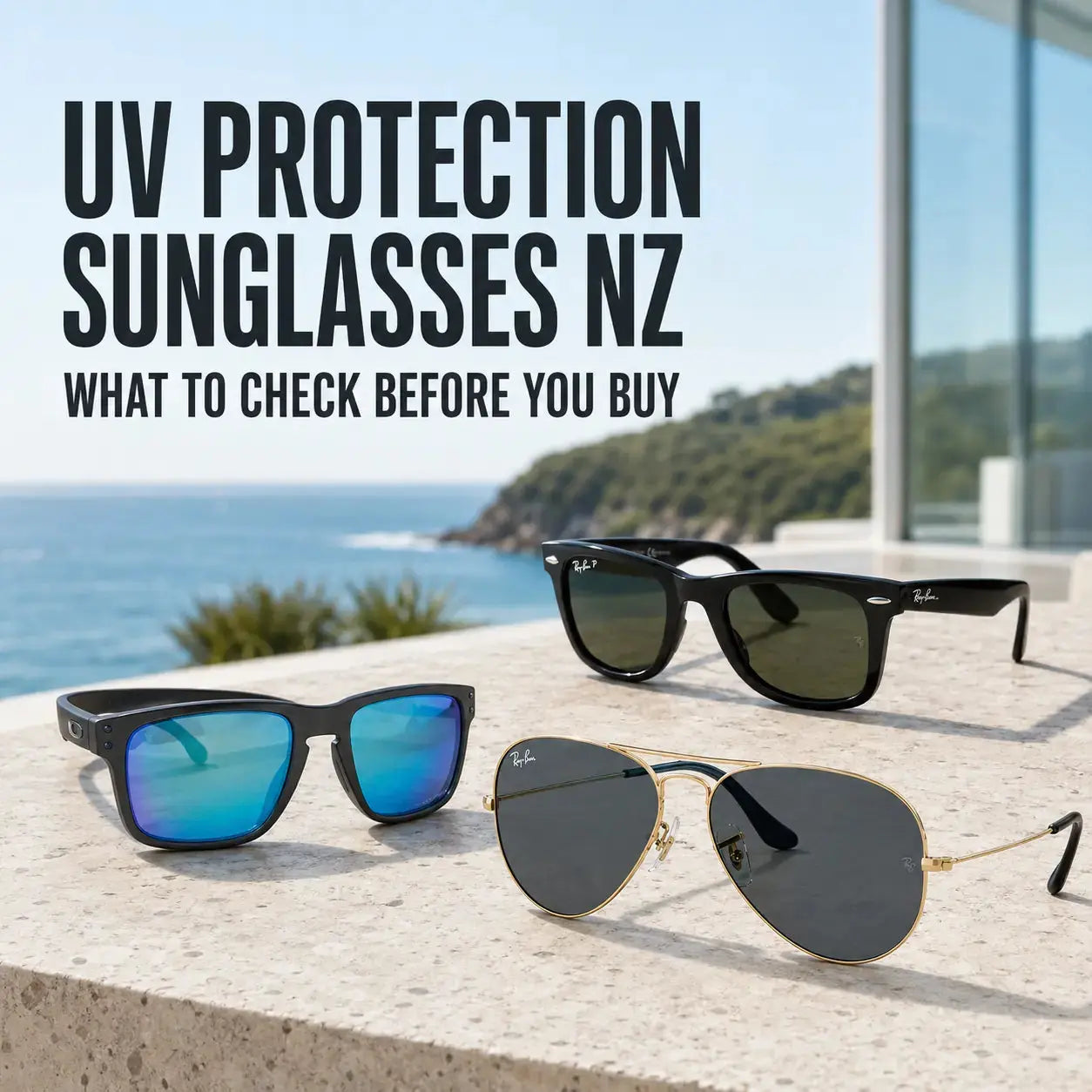
The models below are examples of different frame and lens formats currently listed by Gadgets Online NZ. Specifications can change by colour code, size, production update or supplier batch, so check the current product page and packaging for the exact pair you order.
Ray-Ban Original Wayfarer RB2140 901/58
A classic acetate square frame. The current listing identifies polarised green G-15 category 3 lenses, making it a useful example of how lens type and category should be stated for a specific model code.
Oakley Holbrook XL OO9417 941709
A larger square performance-lifestyle frame. The current listing identifies Prizm Sapphire Polarized lenses and states the manufacturer’s UV filtration claim. Confirm the exact fit and current specification before ordering.
Ray-Ban Aviator Large Metal RB3025 9278R5
A lightweight metal aviator format with an Arista gold frame and blue lenses. Use the exact 9278R5 colour code when checking lens information, category, driving suitability and size.
You can also compare the wider designer sunglasses collection, Ray-Ban sunglasses and Oakley sunglasses.
Online buying checklist before checkout
- Confirm the exact model. Match the model code, colour code and lens description—not just the marketing name.
- Read the UV claim. Look for 100% UVA/UVB, UV400 or a clearly stated equivalent from the manufacturer or supplier.
- Check the standard. Ask whether that exact model meets AS/NZS 1067.1:2016.
- Find the lens category. Make sure it suits your conditions and intended use.
- Confirm driving suitability. Never assume a dark or polarised lens is automatically suitable.
- Compare measurements. Check lens width, bridge and temple length against a comfortable pair you already own.
- Ask before ordering. If a key specification is missing, contact the retailer and keep the written confirmation.
Frequently asked questions
What is the best UV protection for sunglasses in NZ?
Look for a clear claim that the lenses block 100% of UVA and UVB or are UV400, then ask whether the exact model meets AS/NZS 1067.1:2016. Also check the lens category, fit and driving suitability.
Does UV400 mean the lenses are polarised?
No. UV400 describes ultraviolet filtering, while polarisation reduces reflected glare. They are separate features and should be checked separately.
Are darker sunglasses better for UV protection?
Not necessarily. Darker lenses reduce visible light, but colour or darkness alone does not prove UV performance. Check the product’s stated UV specification.
What does AS/NZS 1067.1:2016 mean?
It is the Australian/New Zealand requirements standard for sunglasses and fashion spectacles. It addresses areas including transmittance, filter categories, construction, coverage and labelling. Part 2 contains the associated test methods.
Which lens category is best for everyday use?
Categories 2 and 3 are commonly used for everyday sunglasses: category 2 for medium glare and category 3 for brighter, high-glare conditions. Always follow the exact product label.
Can I drive in category 4 sunglasses?
No. Category 4 lenses are very dark special-purpose lenses and are not suitable for driving. Do not drive in any sunglasses marked as unsuitable for driving and road use.
Are polarised sunglasses better for driving?
Polarised lenses can reduce reflected glare from roads and vehicles, which many drivers find useful. Check that the pair is labelled for driving and that you can read dashboard or head-up displays clearly.
Do expensive designer sunglasses automatically have better UV protection?
No. Price and branding do not replace a UV specification or compliance information. Compare the exact model’s label, lens category and intended-use guidance.
Compare sunglasses with the right questions in hand
Browse sunglasses online, or visit Gadgets Online NZ at 591 Dominion Road, Mount Eden, Auckland. If UV, lens category, polarisation, fit or driving suitability is important to your purchase, contact us about the exact model before ordering.
Sources and further reading
- Earth Sciences New Zealand: UV and ozone
- Healthify: Sunglasses and why it is important to wear them
- Cancer Society Sunscreen: Sunglasses
- Consumer NZ: Sunglasses buying guide
- ARPANSA: Sun protection using sunglasses
Information note: This article provides general shopping information and is not medical or optometry advice. Product details can vary by model, colour code, size, region or production update. Confirm critical specifications on the current product page, packaging or with the retailer before ordering. Consult an optometrist for prescription needs, eye symptoms or individual advice.