If you are comparing EDT vs EDP vs Parfum in NZ, the most important thing to know is that the concentration written on the bottle is only part of the story.
Eau de Toilette, Eau de Parfum and Parfum generally describe different fragrance concentration styles, but a higher concentration does not automatically mean a fragrance will always smell better, project further or last dramatically longer.
The actual result depends on the fragrance formula, ingredients, your skin, how much you apply, where you wear it and even New Zealand's changing weather.
Quick answer
Rather than asking which concentration is universally best, ask which version works best for how you actually want to wear fragrance. EDT often feels brighter and lighter, EDP often brings more body and richness, and Parfum is often deeper and smoother—but the complete formula matters as much as the concentration label.
EDT vs EDP vs Parfum NZ: The quick difference
As a general guide, Eau de Toilette (EDT) usually feels lighter, brighter and more transparent. Eau de Parfum (EDP) often adds more depth, body and richness while remaining versatile. Parfum is typically the richest and most concentrated style, often sitting closer to the skin with a deeper and more rounded character.
| Concentration | Typical approximate range | General character |
|---|---|---|
| Eau de Toilette | 5–15% | Fresh, bright, lighter |
| Eau de Parfum | 15–20% | Fuller, richer, versatile |
| Parfum | 20–30%+ | Deep, concentrated, smooth |
These percentages are guidelines rather than universal rules. Brands formulate fragrances differently, and two perfumes carrying the same concentration label can behave very differently. That is why the bottle should never be judged by “EDT”, “EDP” or “Parfum” alone.
More than just concentration
One of the biggest perfume misconceptions is that an EDP is simply an EDT with more fragrance oil added.
Sometimes a stronger concentration follows the same basic scent direction. But manufacturers can also change the balance of ingredients, introduce new notes, remove others or reinterpret the entire fragrance.
That means the EDT, EDP and Parfum versions of the same fragrance family may have noticeably different personalities. An EDT may emphasise citrus and aromatic freshness. The EDP might introduce warmer spices, woods or sweeter facets. The Parfum may become smoother, darker, creamier or more resinous.
So when comparing fragrances such as Bleu de Chanel EDT, an Eau de Parfum like Narciso Rodriguez Musc Noir EDP, or a Parfum such as Rabanne 1 Million Royal, you are not simply comparing three percentages. You are comparing three complete fragrance compositions.

What is Eau de Toilette?
Eau de Toilette is often the freshest expression in a fragrance range. EDTs frequently emphasise notes such as citrus, herbs, aromatic spices, fresh woods and transparent florals.
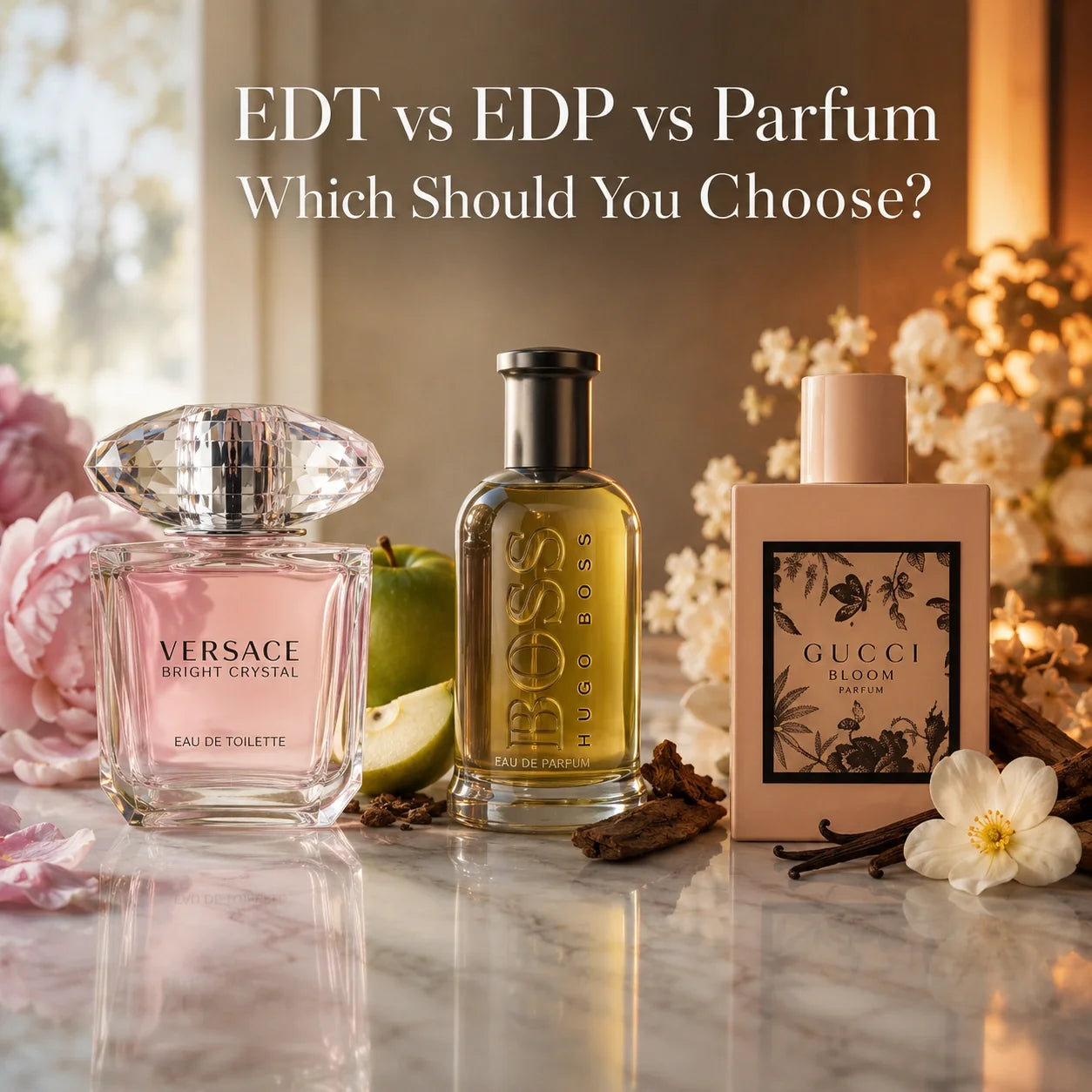
Examples include fragrances such as Versace Bright Crystal EDT, Azzaro Wanted EDT, Chanel Bleu de Chanel EDT and Jimmy Choo Man Intense EDT.
Why choose an EDT?
- Fresh and easy to wear.
- Suitable for daytime.
- Comfortable in warmer conditions.
- Often less dense in close environments.
- Easy to reapply when needed.
An EDT is not automatically “weak”. Some Eau de Toilette fragrances project strongly, and certain formulas can perform longer than richer fragrances from completely different brands. The formula matters more than the letters on the bottle.
What is Eau de Parfum?
Eau de Parfum is one of the most popular concentration styles because it often sits between freshness and richness. Compared with an EDT from the same fragrance family, an EDP may feel smoother, warmer or more substantial.
Examples in our current fragrance range include Hugo Boss Bottled EDP, Giorgio Armani Sì Passione Red Bloom EDP, Givenchy Irresistible Rose Velvet EDP and Narciso Rodriguez Musc Noir EDP.
Why choose an EDP?
- Good everyday versatility.
- More body than a typical EDT.
- Daytime-to-evening wear.
- A richer scent trail.
- Potentially fewer applications through the day.
For many fragrance shoppers, EDP becomes the natural middle ground. But it should not automatically be assumed that an EDP will outperform every EDT.
What is Parfum?
Parfum generally represents a richer concentration style. It may contain a greater proportion of aromatic materials, but how this translates into actual wear can be surprising.
A Parfum may smell deeper and last longer while actually projecting less aggressively than a brighter EDT. That is because richness, longevity and projection are different things.
Examples of Parfum-style fragrances include Gucci Bloom Parfum and Rabanne 1 Million Royal Parfum.
Why choose Parfum?
- Richer scent development.
- A smooth and refined dry-down.
- Strong presence without necessarily filling a room.
- Evening or special-occasion wear.
- A more concentrated fragrance experience.
It can also be a good choice for someone who prefers fragrance to remain closer to the body rather than projecting sharply.
Same name, different expression: Dior Sauvage EDT vs EDP vs Parfum
Dior Sauvage provides a useful example of why concentration should not be viewed as a simple strength ladder.
Dior Sauvage EDT
Dior Sauvage EDT has the brightest character of the three. It emphasises fresh bergamot, pepper, aromatic freshness and clean woody ambroxan. The result is energetic, recognisable and easy to wear.
Dior Sauvage EDP
Dior Sauvage EDP keeps the recognisable Sauvage identity but becomes smoother and warmer. Its composition introduces a more rounded spicy and amber-vanilla character. The overall impression can feel less sharp than the EDT while providing greater depth.
Dior Sauvage Parfum
Dior Sauvage Parfum moves further toward richness and smoothness. Sandalwood, resinous warmth, tonka, vanilla and amber woods contribute to a deeper interpretation.
It does not simply smell like “stronger Sauvage”. It feels like a different expression of the same fragrance idea. That is exactly why testing different concentrations is worthwhile.

Weather changes how fragrance wears in New Zealand
New Zealand conditions can change significantly between locations, seasons and even different parts of the same day.
Temperature can influence how quickly aromatic molecules leave the skin. In warmer conditions, fragrances often open and project more quickly. A rich fragrance that feels perfectly balanced on a cool Auckland evening may feel much more noticeable in warm sunshine. Conversely, colder conditions can make lighter fragrances appear quieter.
This does not mean you need an EDT in summer and Parfum in winter every time. A fresh Parfum can still work beautifully in warmer weather. A spicy EDT can still be an excellent cool-weather fragrance.
For example, the fresh citrus-spice character of Azzaro Wanted EDT behaves very differently from the richer floral-amber personality of Giorgio Armani Sì Passione Red Bloom EDP. The concentration label is only one part of that equation.

Does EDP always last longer than EDT?
No.
EDP often lasts longer than the corresponding EDT from the same fragrance family, but even that is not guaranteed. Longevity depends heavily on the ingredients used.
Some aroma materials naturally remain noticeable for a long time. Others evaporate quickly. A fresh fragrance dominated by bright citrus may change rapidly regardless of concentration, while woods, musks, resins, vanilla and amber-style materials can remain for much longer.
Your skin also matters. Fragrance may persist differently depending on skin moisture, body temperature and application.
For a deeper explanation, read our guide Long-Lasting Perfume NZ: What Really Affects Performance?.
Projection and longevity are not the same
A perfume can have strong initial projection but fade more quickly. Another may remain relatively close to the skin but still be detectable many hours later.
Parfum therefore does not automatically mean “loudest”. In some fragrance families, the EDT creates the brightest and most noticeable opening while the Parfum delivers the longest, smoothest dry-down. Neither is inherently better. They simply serve different preferences.
Choose for how you actually wear fragrance
Before choosing a concentration, think about your real routine.
For everyday work or daytime use, you may prefer something fresh and adaptable. For dinners, events and evenings, you may enjoy additional warmth and depth. If you spend most of your day around other people, projection may matter more than maximum longevity. If you dislike reapplying fragrance, a richer formulation may suit you better. If you enjoy refreshing your fragrance throughout the day, an EDT may be ideal.
Ask yourself three questions
Office, outdoors, evenings, events or everyday life?
Fresh and present, or deeper and closer?
Your preference often matters more than the concentration percentage.
Test the dry-down, not just the label
The first few minutes after spraying fragrance are only the opening. That opening can be exciting, bright and highly volatile, but it may not resemble the fragrance you will actually experience for most of the day.
When comparing EDT, EDP and Parfum, allow them time to develop. Use blotters initially if you are comparing several options, then test your favourites on skin.
A simple dry-down check
This is often where the real differences between concentrations become obvious. A fragrance that initially seems less impressive may become your favourite once it settles.

Should you buy EDT, EDP or Parfum?
There is no universal winner.
- Choose EDT when you enjoy brightness, freshness and easy everyday wear.
- Choose EDP when you want a balance of freshness, richness and versatility.
- Choose Parfum when you prefer deeper, smoother and more concentrated fragrance character.
But always judge the specific fragrance, not just its concentration. Two EDTs can perform completely differently. Two EDPs can smell nothing alike. And a Parfum is not automatically the best version of a fragrance simply because it carries the highest concentration label.
Can you own more than one concentration?
Absolutely. For fragrance families that change meaningfully between concentrations, owning different versions can make sense.
You might enjoy an EDT during warmer daytime conditions and prefer an EDP or Parfum for evenings. Or you may simply prefer the scent structure of one concentration regardless of the weather.
This is particularly relevant with fragrance families such as Dior Sauvage, Bleu de Chanel and other ranges where different concentrations are designed as distinct interpretations.
How to make any concentration perform better
- Apply fragrance to clean skin, particularly around pulse points such as the neck and wrists.
- Moisturised skin can help some fragrances remain noticeable longer.
- Avoid aggressively rubbing your wrists together after spraying.
- Store perfume away from direct sunlight and excessive heat.
- Do not judge performance from the first few sprays alone; your nose can adapt to a familiar scent even while other people can still smell it.
Shop perfumes in New Zealand
At Gadgets Online NZ, we stock a wide selection of men's, women's and unisex fragrances across Eau de Toilette, Eau de Parfum, Parfum and other concentration styles.
For fragrances available to sample, trying a smaller format first can be one of the best ways to compare how a scent develops on your own skin before committing to a full bottle.
Shop online across New Zealand or visit our Mount Eden, Auckland store. Gadgets Online NZ has served New Zealand customers since 2008.
EDT vs EDP vs Parfum FAQ
Is EDP better than EDT?
Not necessarily. EDP generally indicates a richer concentration style, but an EDT may suit you better if you prefer freshness, projection or lighter everyday wear.
Does Parfum last the longest?
Parfum often offers strong longevity, but ingredients, formulation, skin and environment all affect performance.
Is EDT suitable for New Zealand summer?
Many EDT fragrances work extremely well in warmer weather, particularly fresh citrus, aromatic and aquatic styles. However, concentration alone should not determine seasonal suitability.
Should I buy the strongest concentration?
Buy the version whose scent and performance you actually enjoy. Stronger concentration does not automatically mean better fragrance.
Do EDT, EDP and Parfum smell the same?
Sometimes they are closely related, but often the formula changes between concentrations. Different notes may become more or less prominent.
Should I test perfume on paper or skin?
Blotters are useful for comparing several fragrances quickly. Skin testing is better before purchasing because fragrance development varies from person to person.
Final verdict
The difference between EDT vs EDP vs Parfum in NZ is more nuanced than simply “light, medium and strong”.
Concentration can influence richness, development and performance, but the fragrance formula itself matters just as much. Use the label as a starting point. Then consider the fragrance notes, New Zealand weather, occasion, projection, dry-down and how the perfume actually behaves on your own skin.
The best concentration is ultimately the one you enjoy wearing.