
Product and availability audit: 24 November 2026 · New Zealand sunglasses buying guide
Grey, brown, green and blue sunglasses lenses can change how the world looks, but lens colour alone does not tell you the UV protection, polarisation or driving suitability. Start with the exact lens specification, then choose the colour that suits your use and visual preference.
This guide compares the main lens-colour families for New Zealand conditions and uses four current, stocked designer frames as practical examples. It is a decision guide rather than a promise that every lens of the same colour behaves identically.
Quick answer: which sunglasses lens colour should you choose?
- Grey: the most neutral-looking everyday option when you want brightness reduced without a strongly warm cast.
- Brown or amber: a warmer view that many wearers prefer when contrast and changing light matter.
- Green: a classic middle ground with a natural-looking view and a little more character than neutral grey.
- Blue, violet or mirrored: a more expressive or performance-led look; check the exact product specification because the visible colour may come from a mirror coating over another base tint.
- Gradient: darker at the top and lighter lower down. Useful when you want overhead shade with an easier view of a dashboard or phone, but the finish does not by itself confirm UV protection or lens category.
Sunglasses lens colours compared at a glance
| Lens colour or finish | How it usually looks | Good shortlist for | Check before buying |
|---|---|---|---|
| Grey / smoke | Neutral and subdued | Everyday wear, bright urban conditions and buyers who want less colour shift | Lens category, UV claim, polarisation and whether the tint is solid or gradient |
| Brown / amber | Warmer with stronger colour contrast | Variable daylight, travel and buyers who prefer a warmer view | How warm the tint appears and whether it is suitable for your intended activity |
| Green | Balanced, classic and slightly richer than grey | General daytime use and classic Ray-Ban styling | Solid versus gradient, polarisation and the exact green tone |
| Blue / violet / mirrored | Cooler, more reflective or fashion-led | Sport, coastal wear and a more technical or expressive appearance | Base tint, mirror coating, polarisation and activity-specific suitability |
| Gradient | Darker above, lighter below | Fashion wear, commuting and mixed near/far viewing | The exact lens category and whether glare control or polarisation is included |
Lens colour is not the same as UV protection
A dark lens can look protective without telling you how much ultraviolet radiation it blocks. The Cancer Society of New Zealand advises buyers to look for high UV protection and close-fitting coverage; it also notes that lens colour can change contrast but does not improve UV protection by itself.
Likewise, polarisation is a separate feature. Polarised lenses are designed to reduce reflected glare from horizontal surfaces such as roads and water. They do not automatically provide more UV protection than a non-polarised lens with the same verified UV filtering.
Before choosing by colour, check the product description or label for the lens category, UV claim, polarisation and intended use. Our UV Protection Sunglasses NZ guide explains the buying checks, while Polarised vs Non-Polarised Sunglasses NZ covers reflective glare in more detail.
Grey lenses: the neutral everyday choice
Grey and smoke lenses are popular because they tend to keep the view comparatively neutral. They are a sensible starting point for bright everyday conditions, commuting and anyone who does not want a strongly warm tint.
The live Prada PR 27ZS 16K08Z Black Dark Grey 54mm pairs a black frame with dark grey lenses. It is the most straightforward fashion example in this guide: the frame and lens read as one restrained, monochrome look.
Do not assume every grey lens has the same darkness. A solid dark-grey lens, a pale smoke tint and a grey gradient can sit in different categories and feel different in use. Check the exact variant rather than relying on the word “grey”.
Brown and amber lenses: warmer contrast
Brown, amber and bronze-family lenses create a warmer view and can make changes in light and surface detail feel more defined. Some people find this comfortable for travel, outdoor leisure and variable daylight; others prefer the more neutral appearance of grey.
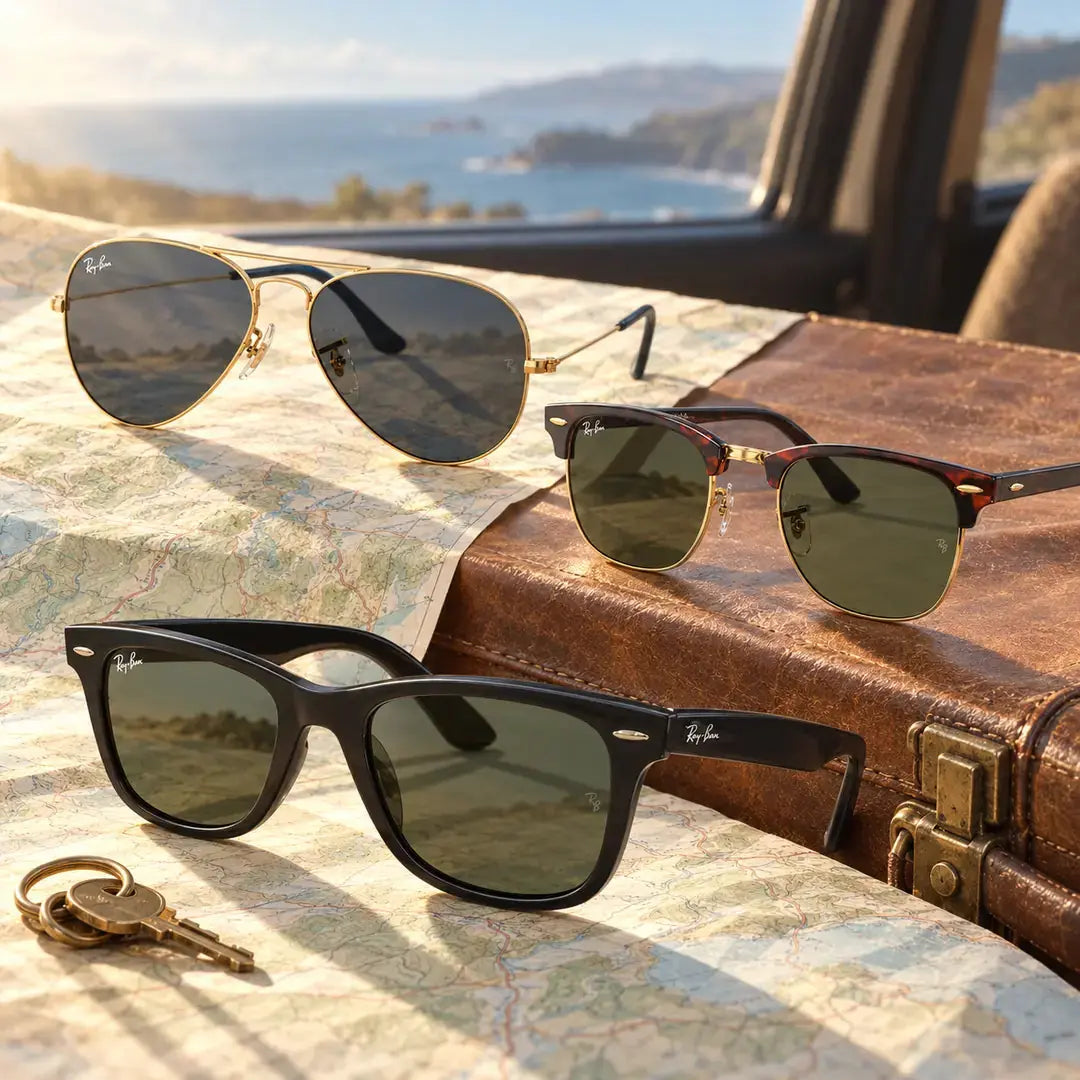
The Ray-Ban Aviator Max RB3925 001/51 Arista Gold Clear Gradient Brown 58mm is a useful example because the warm brown is also a gradient. The darker upper area helps with overhead brightness, while the lighter lower section changes how the lens looks across the face.
A brown gradient is not automatically polarised. If glare from roads or water is the priority, confirm that feature separately.
Green lenses: a classic middle ground
Green lenses sit between neutral grey and warm brown for many wearers. They can retain a natural-looking scene while adding a distinct classic eyewear character.
The Ray-Ban Jack RB3565 919631 Gold Green 53mm shows that classic pairing: a slim gold frame with green lenses. Ray-Ban describes its G-15 family as an everyday lens direction, but the exact treatment still matters—solid, gradient and polarised versions are different buying choices.
If you like green but need reflected-glare control, look for an exact polarised variant rather than assuming the colour itself performs that job.
Blue, violet and mirrored lenses: check the base tint
A blue or violet appearance may come from the base tint, a mirror coating, or both. That is why two lenses that look similarly blue in a product photo can produce a different view when worn.
The Oakley Holbrook XL OO9417 941707 Clear Prizm Sapphire Polarised 59mm is the performance-led example in this guide. Oakley’s official Prizm information explains that its lens families are tuned to enhance colour and contrast, and this exact Shopify variant also specifies polarisation. Treat the full name as the specification: Prizm Sapphire, polarised, and the 59mm frame size all matter.
For driving, do not choose by fashion colour alone. Use the exact manufacturer specification and the product’s stated lens category. Our Best Sunglasses for Driving NZ guide covers daytime driving, glare and display checks.
Solid, gradient, mirrored and polarised: four different decisions
Solid tint
The colour and density stay broadly consistent across the lens. This is the simplest appearance to compare, but the actual darkness still varies by model.
Gradient tint
The lens transitions from darker at the top to lighter lower down. Ray-Ban describes a simple gradient as a smooth transition within the same colour family. It can be useful when overhead brightness is strong but you still want a clearer lower field of view.
Mirror or flash coating
A reflective surface treatment changes the outward appearance and can reduce visible light transmission. The colour seen from the outside may not be the same as the colour experienced through the lens.
Polarisation
Polarisation targets reflected glare. It can be combined with grey, brown, green, blue or mirrored finishes, so it should be checked as its own feature rather than inferred from colour.
Which lens colour suits your use?
For everyday Auckland wear
Start with grey or green if you want a versatile, natural-looking option. Then choose the frame by fit and measurements, not colour alone.
For changing light and travel
Brown or amber can be comfortable when conditions move between bright and hazy. A gradient can also be useful, provided the exact lens category suits the activity.
For water, road glare or outdoor sport
Prioritise polarisation and coverage first. Then compare colour, mirror finish and activity-specific technology. Oakley Prizm and Ray-Ban polarised variants are not interchangeable simply because both may appear blue or green.
For a fashion-led look
Blue, violet, mirrored and gradient lenses create the biggest visual statement. Check how the lens changes the view as well as how it looks from the outside.
Compare current sunglasses by exact lens specification
Browse the full Designer Sunglasses NZ range, or compare current Ray-Ban sunglasses, Oakley sunglasses and Prada sunglasses.
The four exact products featured in this guide were active with positive Shopify inventory when checked on 24 November 2026. Use the live product pages for current availability. Shop online with NZ-wide delivery or visit Gadgets Online NZ in Onehunga, Auckland.
Frequently asked questions
What is the best sunglasses lens colour for everyday use?
Grey is the most neutral starting point, while green offers a classic balanced alternative. The better choice depends on your visual preference, the exact lens category, fit and whether you need polarisation.
Are brown lenses better than grey lenses?
Not universally. Brown gives a warmer, more contrast-led view; grey tends to look more neutral. Compare them in the conditions where you will actually wear the sunglasses.
Do darker lenses provide more UV protection?
Not necessarily. Darkness and colour do not prove the UV filtering. Check the verified UV claim and relevant standard information for the exact pair.
Are gradient lenses good for driving?
They can be comfortable for daytime driving because the lower area may make the dashboard easier to view, but the exact lens category and manufacturer guidance determine suitability. Category 4 lenses are not for driving.
Does blue mirror mean the view through the lens is blue?
Not always. A mirror coating can create a blue appearance from the outside while the base tint seen by the wearer is different. Check the full lens description.