Learning how to choose a signature scent is not about finding the most expensive bottle, the strongest concentration or whichever perfume is receiving the most attention online.
A signature scent should feel natural in your life. It should suit the way you dress, the environments in which you spend time, the level of fragrance presence you enjoy and the character you want your perfume to communicate.
For some people, that means one fragrance worn almost every day. For others, it means one central scent supported by a small rotation for work, evenings and special occasions.
This seven-step New Zealand guide will help you narrow your scent character, understand fragrance families, follow the dry-down, test perfume properly and decide whether one bottle or a small scent wardrobe works better for you.
How to Choose a Signature Scent: Quick Answer
A reliable signature-scent process looks like this:
- Decide how you want your fragrance to feel.
- Narrow your preferred fragrance families.
- Evaluate the opening, heart and dry-down.
- Test on paper and then on your own skin.
- Treat EDT, EDP and Parfum as guides—not rankings.
- Wear the fragrance in your normal environment.
- Choose one anchor scent or a small, purposeful wardrobe.
The right fragrance is the one you continue to enjoy after the first impression has faded.
What Is a Signature Scent?
A signature scent is a fragrance that feels closely connected with your personal style.
It does not need to be rare. It does not need to fill an entire room. And it does not need to receive compliments from everyone around you.
The most important test is whether the fragrance feels comfortable, recognisable and appropriate for the way you actually live.
A successful signature scent usually satisfies three questions:
- Do I enjoy the complete fragrance—not only its first spray?
- Can I wear it comfortably in the places I visit most often?
- Does it feel like my choice rather than someone else’s recommendation?
That is why choosing by scent character is more useful than beginning with a brand name.

Step 1: Choose Your Scent Character
Before comparing individual perfumes, decide what you want your fragrance to communicate.
You do not need technical perfume vocabulary at this point. Start with a feeling.
Do you want to smell fresh and effortless, modern and minimal, polished and elegant, warm and comforting, or bold and memorable?
| Scent character | General direction | Catalogue example |
|---|---|---|
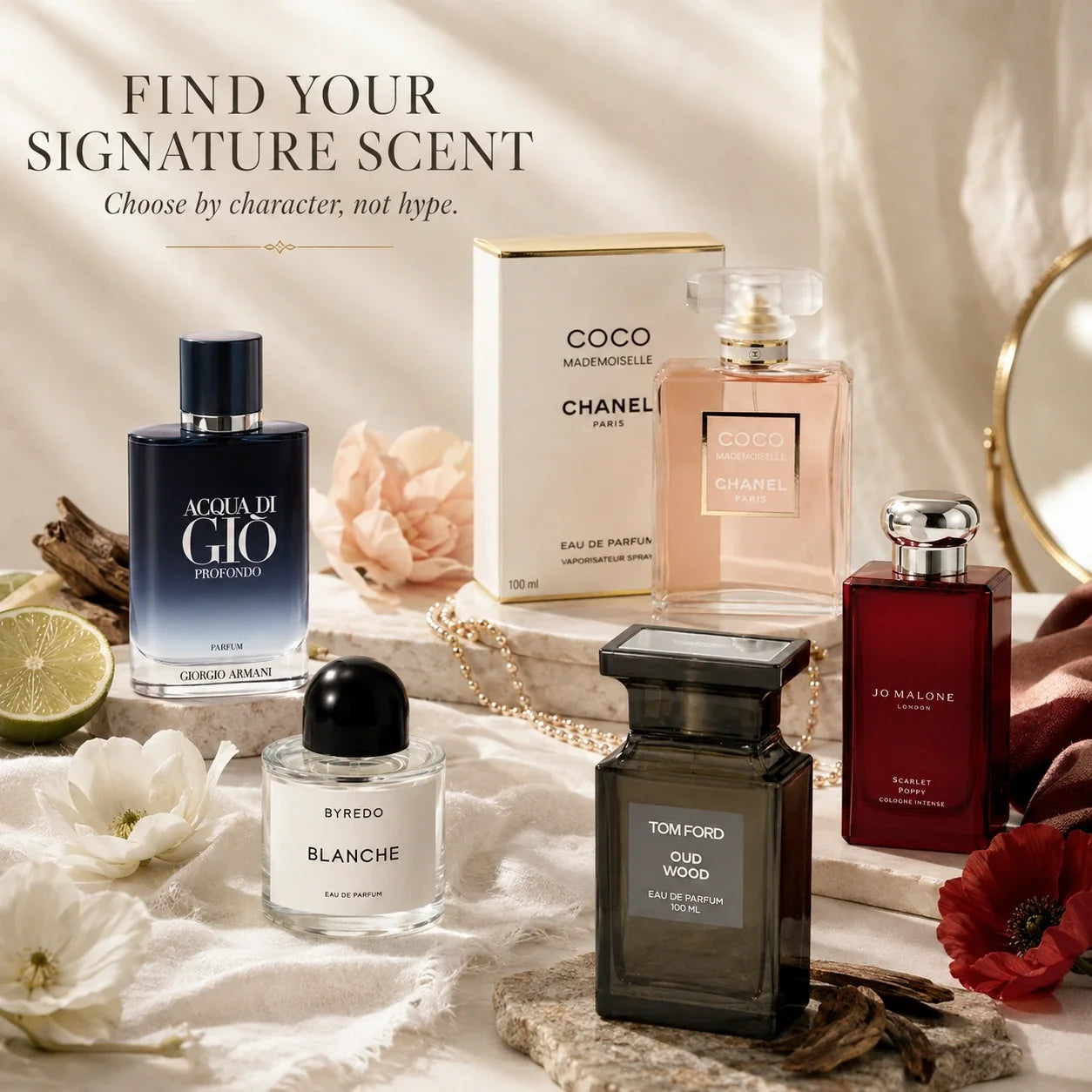
| Fresh & Easy | Marine, citrus, aromatic and clean | Giorgio Armani Acqua di Giò Profondo Parfum |
| Modern & Minimal | Aldehydes, soft florals, musk and smooth woods | Byredo Blanche |
| Polished & Elegant | Bright citrus, refined florals and structured woods | Chanel Coco Mademoiselle |
| Warm & Comforting | Powdery florals, iris and tonka warmth | Jo Malone Scarlet Poppy |
| Bold & Memorable | Oud-style woods, exotic woods and amber | Tom Ford Oud Wood |
These examples were deliberately selected because they represent five genuinely different scent personalities rather than five similar perfumes in different bottles.
Fresh & Easy: Giorgio Armani Acqua di Giò Profondo Parfum
Choose this direction if you enjoy freshness but do not want your fragrance to feel thin or overly simple.
Acqua di Giò Profondo Parfum combines a deep marine impression with aromatic, floral and resinous-woody depth. It demonstrates that a Parfum can still feel fresh and oceanic rather than automatically dark or sweet.
Shop Giorgio Armani Acqua di Giò Profondo Parfum 100ml
Modern & Minimal: Byredo Blanche
Byredo Blanche suits someone who prefers fragrance to feel clean, quiet and close rather than highly decorative.
Its profile centres on aldehydic freshness, rose and soft florals over musk and sandalwood, giving it a clean-linen character without making it completely plain.
Polished & Elegant: Chanel Coco Mademoiselle
Coco Mademoiselle represents a more composed and recognisably polished fragrance character.
Its structure moves from bright citrus into jasmine and rose before settling into a deeper patchouli-and-vetiver direction. That contrast is also why it works well for demonstrating how a fragrance changes after the opening.
Shop Chanel Coco Mademoiselle EDP 100ml
Warm & Comforting: Jo Malone Scarlet Poppy
Scarlet Poppy moves into a softer, more enveloping direction.
Its poppy-inspired floral character, velvety iris and tonka warmth make it useful for someone who wants fragrance with more texture and comfort than a transparent daytime floral.
Shop Jo Malone London Scarlet Poppy Cologne Intense 100ml
Bold & Memorable: Tom Ford Oud Wood
Oud Wood is the deepest and woodiest of these five starting points.
Its oud-style woods, exotic woods and amber warmth suit someone who wants a more distinctive woody presence without choosing fragrance solely by sweetness or projection.
Shop Tom Ford Oud Wood EDP 100ml
These categories are starting points, not gender rules. Someone can enjoy Blanche, Oud Wood or Scarlet Poppy regardless of how the bottle is traditionally marketed.
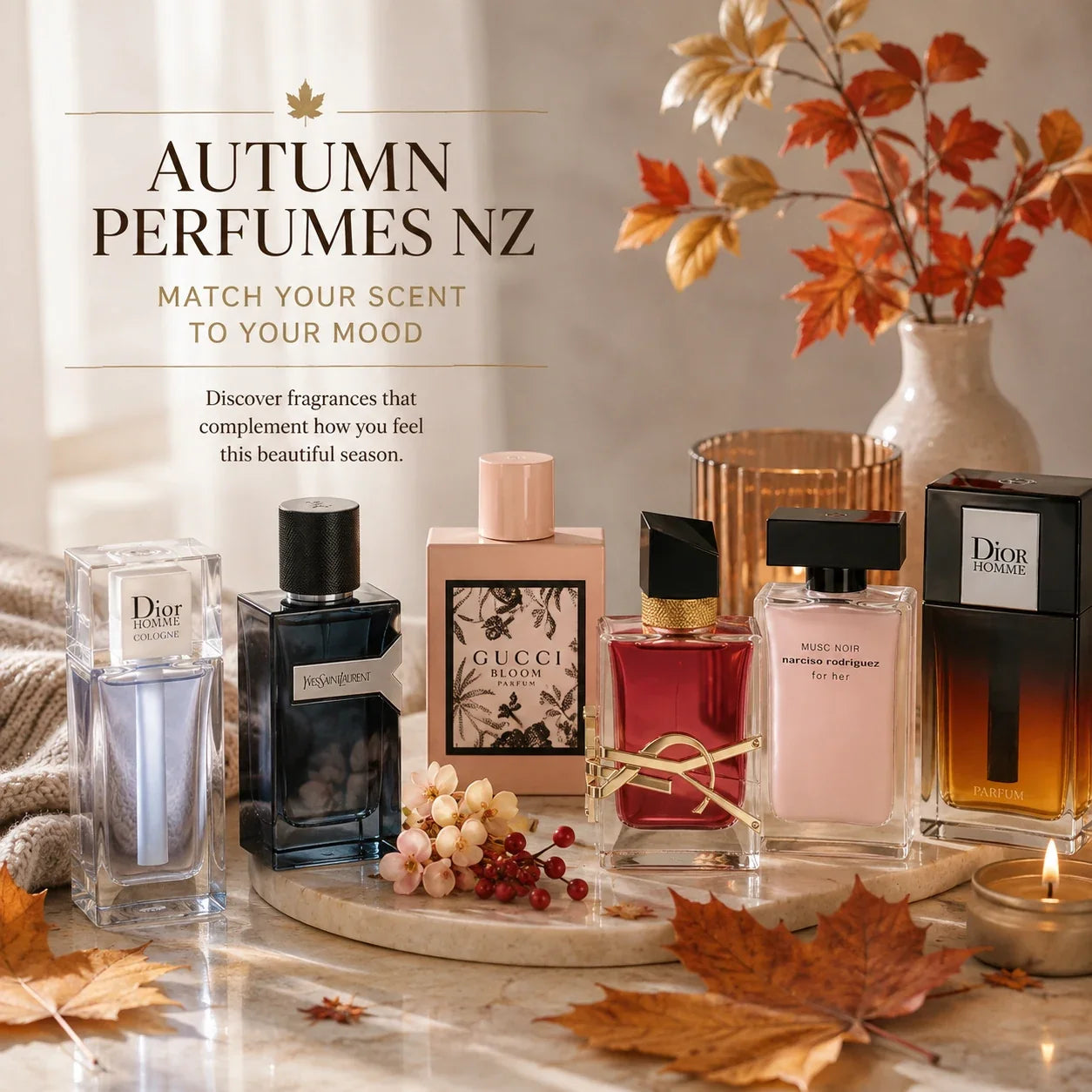
For another way of choosing fragrance by feeling and occasion, read our Autumn Perfumes NZ mood guide.
Step 2: Narrow Your Preferred Fragrance Families
Once you know the character you want, fragrance families make comparison easier.
Fresh, Citrus and Aquatic
These fragrances may use citrus, marine, green or aromatic effects. They often appeal to people who want fragrance to feel clean, energetic or easy to wear.
Floral and Musky
Floral fragrance can be light and transparent, creamy and warm, powdery, sweet or deeply textured. Do not assume that every floral perfume smells traditionally feminine or belongs only in spring.
Woody and Chypre
Woody compositions may feel dry, smooth, earthy, polished or warm. Chypre-style fragrances often combine brightness with a deeper structure, creating contrast between the opening and dry-down.
Amber and Gourmand
These profiles can include vanilla, tonka, balsamic warmth, resins, spices or edible-style accords. They often feel enveloping, although not every amber or gourmand fragrance is automatically strong.
Oud, Leather, Incense and Deeper Woods
These materials can produce bold or atmospheric fragrance styles. But seeing “oud” in a title does not tell you everything about the final composition. Oud may be soft and polished in one perfume and dark or smoky in another.
Fragrance families frequently overlap. A perfume can be floral and woody, fresh and aromatic, or ambered and spicy at the same time.
Our Perfume Notes Explained guide explains these relationships in more detail.

Step 3: Follow the Dry-Down
The first spray is not the complete perfume.
A fragrance normally changes as its more volatile materials fade and its longer-wearing structure becomes clearer.
Opening
The opening creates the first impression. It may feel citrusy, green, aromatic, sparkling, spicy or immediately sweet. Because this stage is designed to attract attention quickly, it can also be the easiest part to overvalue.
Heart
The heart reveals more of the fragrance’s central character. Florals, spices, fruits or aromatic materials may become clearer once the brightest opening has softened.
Base and Dry-Down
The base is the part that remains after the fragrance has settled. Woods, musk, amber-style materials, patchouli, vanilla, tonka, leather or resins may become more noticeable here.
The timing is not identical for every perfume or every wearer. Treat the stages as a progression rather than a strict clock.
Coco Mademoiselle as a Dry-Down Example
Coco Mademoiselle works well as a visual example because its structure moves from vivid citrus into jasmine and rose, then toward patchouli and vetiver.
Someone who tests only the citrus opening has not yet experienced the part of the fragrance that will remain with them later.
A signature scent must pass the dry-down test. You should enjoy what the perfume becomes—not merely how it introduces itself.

Step 4: Test Before You Commit
Testing is the most important stage of choosing a signature scent.
A beautiful bottle, famous name or impressive online review cannot tell you whether you will enjoy wearing the fragrance for several hours.
Start With a Blotter
A paper blotter helps remove fragrances you immediately dislike. Use it to assess the broad opening and general direction. It is a screening tool, not the final decision.
Move to a Skin Test
Once a perfume interests you, test it on clean skin. Skin temperature, moisture, application and environment can all influence how noticeable and balanced the fragrance feels.
Allow it to dry naturally rather than immediately rubbing the application area.
Wear It for Several Hours
Continue with your normal day. Notice the scent indoors, outdoors and after the opening has softened. Ask yourself whether it remains enjoyable when you are no longer concentrating on it.
Keep a Simple Fragrance Journal
You do not need complex terminology. Record:
- First impression
- How it feels after one or two hours
- What remains later
- Where you would wear it
- Whether you genuinely want to smell it again
The final question is the most useful. A signature scent should create the desire to wear it—not the feeling that you ought to like it because other people do.
Where available, explore our Perfume Samples NZ collection before committing to a full bottle.
Step 5: Do Not Treat EDT, EDP and Parfum as a Quality Ranking
Concentration is important, but it does not decide whether a fragrance suits you.
An Eau de Toilette can become an excellent signature scent. An Eau de Parfum can feel too rich for someone’s daily environment. A Parfum can be fresh rather than dark. And a fragrance called Cologne Intense may feel warmer and richer than its name initially suggests.
The five products in this article demonstrate that clearly:
- Acqua di Giò Profondo is a marine-style Parfum.
- Blanche is an Eau de Parfum with a clean, minimal personality.
- Coco Mademoiselle is an Eau de Parfum with citrus, floral and chypre-style contrast.
- Scarlet Poppy belongs to Jo Malone’s Cologne Intense range but has a warm, enveloping profile.
- Oud Wood is an Eau de Parfum centred on woods and amber.
Treat concentration as information—not as a verdict. The complete composition, your preferred spray level and your normal environment matter more than blindly choosing whichever format sounds strongest.
Read our EDT vs EDP vs Parfum NZ guide for the full concentration comparison.
Step 6: Wear the Fragrance in Your Real Life
A signature scent must work outside the perfume counter.
Test it during the kinds of days for which you intend to wear it. That may include:
- Work or study
- Driving and commuting
- Indoor meetings
- Outdoor time
- Dinner
- Social events
- Travel
- Warm or cool weather
A fragrance that feels perfect during a quiet evening may not be comfortable in a close office. A fresh scent that seems restrained indoors may feel ideal during an active day. A richer fragrance may need fewer sprays than you first expect.
Ask These Four Questions After a Full Wear
- Do I still enjoy the dry-down?
- Is the fragrance comfortable in shared spaces?
- Does it suit most of the clothes and settings in my real life?
- Would I reach for it without needing a special reason?
Do not rely completely on another person’s longevity report. Performance and perception vary with formula, application, skin, clothing, temperature and environment.
Our Long-Lasting Perfume NZ guide explains why one fixed number of hours cannot reliably describe every wearer’s experience.
For seasonal context, see Summer vs Winter Perfumes NZ.

Step 7: Choose One Anchor Scent or Build a Small Wardrobe
You do not need a large perfume collection to express different parts of your style.
There are two sensible approaches.
Option 1: One Anchor Signature Scent
Choose one versatile perfume that works for the majority of your week. This is ideal if you enjoy consistency and want your fragrance to become closely associated with you.
Option 2: A Small Signature Wardrobe
Choose a small number of perfumes with clearly different purposes.
| Moment | Desired character | Example from this guide |
|---|---|---|
| Daily | Fresh, composed and easy to wear | Acqua di Giò Profondo Parfum |
| Evening | Warm, textured and inviting | Jo Malone Scarlet Poppy |
| Special occasion | Distinctive, woody and memorable | Tom Ford Oud Wood |
This does not mean everyone needs three bottles. The purpose is to avoid random buying. Each fragrance should have a clear role.
A useful fragrance wardrobe might contain two perfumes rather than three: one everyday scent and one richer alternative.
Your “signature” then comes from the consistent character of your choices—not necessarily from wearing the same bottle every day.
Common Signature-Scent Mistakes
Buying Because the Fragrance Is Trending
Popularity tells you that many people know the fragrance. It does not tell you whether you will enjoy its dry-down.
Choosing Only by the Bottle
Packaging can be part of the experience, but it should not overrule the fragrance itself.
Testing Too Many Perfumes at Once
A crowded testing session makes fragrances harder to compare. Keep the process focused and return another day when necessary.
Judging Only the First Few Minutes
The opening may be completely different from what remains later.
Assuming Stronger Means Better
A fragrance that overwhelms your normal environment is not a more successful signature scent.
Following Gender Labels Too Rigidly
Traditional categories can help organise a store, but your own preference should make the final decision.
Copying Someone Else’s Signature Scent
A perfume can be perfect for another person and still feel wrong for you. Use recommendations to find candidates, not to replace testing.
Should a Signature Scent Get Compliments?
Compliments can be enjoyable, but they are not the main measurement of a successful perfume.
A loud fragrance may receive more immediate attention simply because more people can smell it. That does not make it more personal, more elegant or better suited to your life.
A good signature scent should first be comfortable to wear, enjoyable through the dry-down and appropriate for your normal environment.
Consider compliments a bonus—not the selection method.
How Long Should You Test a Perfume Before Buying?
One several-hour wear test is more useful than a quick smell from the cap or blotter.
For a major full-bottle purchase, testing the fragrance again on another day can also help.
Your first session may be influenced by other perfumes in the air, the weather, your expectations or simple sensory fatigue. A second wear can confirm whether the attraction lasts beyond novelty.
How to Choose a Signature Scent FAQ
What is a signature scent?
A signature scent is a fragrance strongly associated with your personal style. It should feel comfortable, recognisable and suitable for the way you normally live and wear perfume.
How do I find my signature scent?
Begin with the character you want—such as fresh, minimal, elegant, comforting or bold. Narrow the fragrance families, test promising options on skin and assess the full dry-down before buying.
Can I have more than one signature scent?
Yes. Some people prefer one consistent fragrance, while others use a small wardrobe for daily wear, evenings and special occasions. Both approaches can create a recognisable personal fragrance style.
Should a signature scent be EDT, EDP or Parfum?
No single concentration is required. An EDT, EDP, Parfum or another format can all work. Choose according to the actual composition, your preferred level of presence and your normal environment.
How long should I test perfume before buying?
Wear it for several hours so you can experience the opening, heart and dry-down. For an expensive or uncertain purchase, repeating the test on another day can provide a clearer decision.
Why does perfume smell different on paper and skin?
Paper is useful for assessing the opening, but it does not reproduce skin temperature, moisture, clothing or your normal environment. A skin test gives a more relevant picture of how the fragrance feels when worn.
Can a unisex fragrance be a signature scent?
Absolutely. A fragrance’s marketing category does not determine whether it suits you. Fresh, floral, musky, woody, amber and oud-style fragrances can all be selected according to personal preference.
Is expensive perfume automatically a better signature scent?
No. Price, brand recognition and packaging do not guarantee personal suitability. A successful signature scent is one whose character, dry-down and wear experience fit you.
Should I buy a full bottle without sampling first?
Sampling is preferable where available, especially for a costly fragrance or a scent family you do not already know. When samples are unavailable, test on skin in-store and allow the perfume time to develop before deciding.
Explore Signature-Scent Options in New Zealand
Browse our complete Perfumes & Fragrances NZ collection, compare Men’s Perfume NZ and Women’s Perfume NZ, or look beyond traditional categories through Unisex Fragrances NZ.
You can also explore Perfume Gift Sets NZ or begin with smaller options through Perfume Samples NZ.
Before comparing retailers, read our Authentic Perfume NZ guide.
Gadgets Online NZ has served New Zealand customers since 2008, with online shopping across New Zealand and a physical retail store in Mount Eden, Auckland.
Shop online across New Zealand or visit our Mount Eden store.
Final Verdict
The best signature scent is not the fragrance with the loudest projection, highest price or most recognisable bottle.
It is the perfume you enjoy after the opening has faded. It fits comfortably into your real life. It represents the character you want to wear. And it makes you want to return to it without needing online hype to justify the choice.
Start with scent character, test the dry-down and commit only when the fragrance continues to feel like you.