History of perfume: the quick answer
The history of perfume stretches back thousands of years. Ancient cultures burned aromatic resins and wore perfumed oils long before modern alcohol-based fragrance existed. Egyptian, Greek and Roman scent traditions were followed by major advances in distillation across the medieval Islamic world and Europe, the rise of specialist European perfumery, and the late-nineteenth-century expansion of synthetic aroma materials that helped shape modern fragrance.
Perfume did not begin with a designer bottle, an Eau de Parfum concentration or even alcohol.
The history of perfume runs through incense smoke, perfumed oils, sacred ritual, medicine, bathing, trade, chemistry and eventually the global fragrance industry we know today.
Ancient societies across the Near East, Egypt, Greece and Rome used aromatic materials long before perfume looked anything like the fragrance we buy now. Later, advances in extraction and distillation changed how scent could be captured and preserved. By the late nineteenth century, synthetic aroma materials expanded the perfumer’s palette again and helped create modern perfumery.
Today, designer fragrance, niche perfumery and contemporary Arabic fragrance traditions continue that long story in different ways.
When Was Perfume Invented?
There is no single reliable date when perfume was invented, and it would be misleading to credit one person or civilisation with creating the whole idea.
Archaeological and museum collections show perfume-related vessels, incense and aromatic preparations across the ancient Near East and Egypt several millennia ago. Fragrance therefore developed gradually through many cultures rather than appearing as one invention.
A better question is: how did humans move from burning aromatic materials and wearing perfumed oils to the spray fragrances we use today?
Perfume History Timeline
| Period | What changed |
|---|---|
| Ancient Near East | Aromatic resins, oils and incense become important in ritual, personal care and trade. |
| Ancient Egypt | Perfumed oils, ointments and incense are used in personal, religious and funerary contexts. |
| Ancient Greece | Scented oils become closely associated with grooming, athletics, social life and ceremony. |
| Roman world | Fragrance culture expands alongside bathing, cosmetics and specialised glass perfume containers. |
| Medieval Islamic world | Distillation techniques and alembic apparatus become increasingly important to perfume, medicine and chemistry. |
| Medieval & Renaissance Europe | Distillation knowledge spreads and alcohol-based fragrance becomes increasingly practical. |
| Grasse & European perfumery | Specialist fragrance craft develops into a major European perfume industry. |
| Late 19th century | Synthetic aroma materials greatly expand what perfumers can formulate. |
| 20th century to today | Fashion houses, specialist perfume brands, niche perfumers and modern Arabic houses build a global fragrance culture. |
Ancient Perfume: Before the Spray Bottle
Early perfume was often very different from today’s fragrance. Instead of spraying an alcohol-based liquid onto skin, people could burn fragrant materials as incense, infuse aromatic plants and resins into oils or fats, or use scented preparations as cosmetics and ointments.
Ancient fragrance-making therefore included methods such as maceration and capturing aromatic materials in oils or fats rather than the modern perfume distillation and atomiser systems we recognise today.
An ancient “perfume” might have resembled a scented oil, balm or incense far more than a contemporary Eau de Parfum.

Ancient Egypt: Sacred Oils, Resins & Rituals
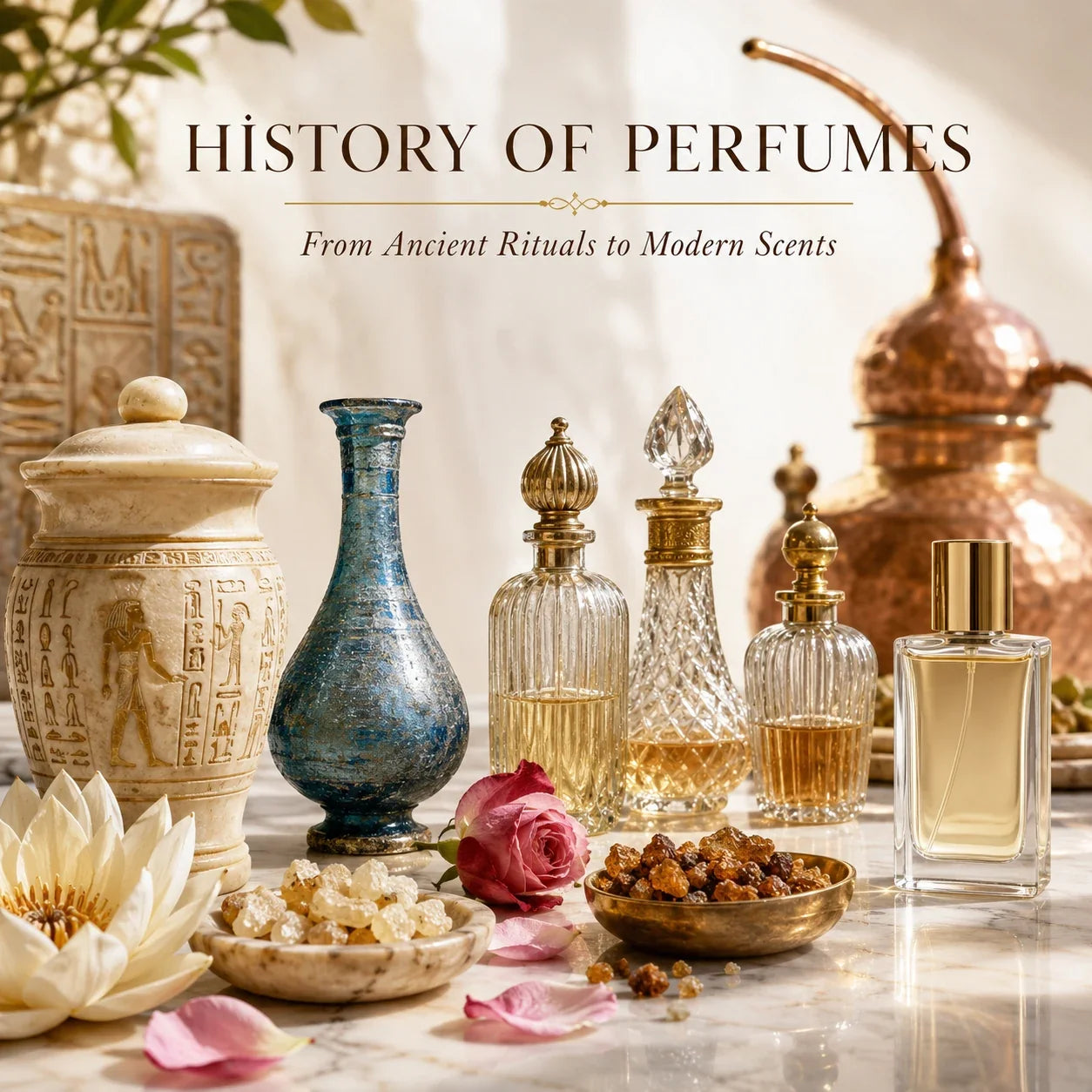
Ancient Egypt provides some of the clearest physical evidence for early fragrance culture. Surviving stone and glass vessels were used to hold perfumed oils, ointments and cosmetics, showing that scent had a practical place in everyday grooming as well as a symbolic one.
Fragrance also had ceremonial and funerary roles. Sacred oils and incense were connected with offerings, temple practice and burial traditions, while aromatic materials moved through extensive trade networks.
What did ancient Egyptian perfume smell like?
There was no single “Egyptian perfume.” Recipes and materials changed over long periods, and different preparations served different purposes. Resins, woods, plant oils, spices and floral materials all appear in the broader scented world of ancient Egypt.
What matters for understanding modern perfume is the principle: people were deliberately combining aromatic materials to create scent experiences thousands of years ago.
Greece & Rome: Perfume Moves Into Daily Life
As fragrance culture developed around the Mediterranean, perfumed oils became increasingly connected with grooming, athletics, bathing, social occasions and funerary practices.

Greek aryballoi were small vessels used to hold oils or perfume, with narrow openings that helped control the flow of a valuable product. Roman glass unguentaria likewise survive in large numbers and were used for scented oils, perfumes and cosmetic preparations.
The container was therefore already becoming part of the fragrance experience long before modern perfume houses existed.
That relationship between scent + vessel + personal identity is still visible every time a contemporary perfume is given a distinctive bottle.
Perfume Trade Connected the Ancient World
Fragrance was never just a local story. Frankincense, myrrh, spices, woods and other aromatic commodities moved through trading networks linking southern Arabia, northeastern Africa, the Mediterranean and parts of Asia.
Ancient South Arabian kingdoms became important participants in the movement of incense, perfumes and aromatics by sea and overland routes.
This helps explain something that remains true today: perfumery has always been international. A single modern formula can combine creative influences and aroma materials associated with several regions.

Distillation Changed the History of Perfume
One of the biggest technological shifts in perfume history was the development and refinement of distillation.
An alembic allows vapour produced by heating a liquid mixture to be collected and condensed. Distillation apparatus in the medieval Islamic world was used in perfume, medicine and chemical work, while sophisticated fragrant waters—especially rose preparations—became part of a wider scientific and craft tradition.
This part of the story matters because simplified perfume histories sometimes jump directly from Egypt and Rome to France. That misses an important bridge.
The perfume industry that later flourished in Europe was shaped by centuries of technical development and knowledge exchange across the Mediterranean and Islamic world.
From Apothecary Craft to Alcohol-Based Perfume
European perfumery changed as distillation knowledge spread and alcohol became more useful as a fragrance carrier.
That gradually made possible fragrances that behaved differently from the heavy oils, balms and fumigations of earlier periods. Alcohol can carry volatile aromatic materials and evaporate from skin, helping create the diffusion associated with modern perfume.
This is one of the major steps toward today’s Eau de Cologne, Eau de Toilette, Eau de Parfum and Parfum formats. If you want to understand those concentration labels, read our EDT vs EDP vs Parfum NZ guide.
Why Did Grasse Become Famous for Perfume?
The French town of Grasse became closely associated with European perfumery through access to aromatic raw materials, specialist craft and eventual industrial development.
Grasse is important—but it should not be described as the place where perfume itself was invented. Perfume history began thousands of years earlier.
Grasse’s significance lies in the evolution of modern European perfumery, especially the specialist craft and industry that connected natural raw materials with increasingly sophisticated fragrance creation.
The Synthetic Revolution Created Modern Perfumery
The late nineteenth century changed perfume again. Developments in organic chemistry gave perfumers access to new synthetic aroma materials. Instead of relying only on naturally extracted materials, perfumers could use molecules that recreated, intensified or entirely reimagined scent effects.
Fragrances such as Houbigant’s Fougère Royale in the 1880s and Guerlain’s Jicky later in that decade are often discussed in connection with the transition toward modern synthetic-material perfumery.
Synthetic does not automatically mean inferior. Modern perfumery commonly combines creative formulation with both naturally derived and synthetic aroma materials. That expanded palette lets perfumers create effects that nature alone cannot always provide consistently—or sometimes at all.
For an explanation of how top, heart and base notes shape the overall experience, see our Perfume Notes Explained guide.
Modern Scents: Designer, Niche & Global Influence

The twentieth and twenty-first centuries transformed perfume into a global consumer and creative industry.
Fashion houses increasingly treated fragrance as an extension of style and identity, while specialist perfume houses continued to develop scent as a craft in its own right.
Today, fragrance shoppers encounter several overlapping worlds. Designer perfumery connects scent with global fashion houses. Niche perfumery often puts greater emphasis on the fragrance concept, perfumer or unusual composition. Contemporary Arabic fragrance houses have brought renewed global attention to amber, musk, incense, rose, spice, woods, gourmand accords and oud—although Arabic perfume is not automatically oud perfume.
That diversity makes today’s fragrance market closer to perfume history than it may first appear: cultures, ingredients and techniques continue to influence one another.
Explore our Arabic Perfumes NZ collection or browse the wider Perfumes & Fragrances NZ range to compare different fragrance directions.
How Is Modern Perfume Different From Ancient Perfume?
Modern perfume benefits from chemistry, more standardised manufacturing, atomisers, global ingredient sourcing and far more precise control over formulation.
But the fundamental idea has barely changed: combine aromatic materials to create an experience people want to smell again.
Ancient perfumers worked with the technology and materials available to them. Modern perfumers have a much larger palette. The purposes—ritual, grooming, pleasure, identity, memory, attraction and self-expression—have evolved without disappearing.
From Sacred Scent to Signature Scent
One of perfume history’s most interesting changes is the movement from collective meaning to individual identity.
Ancient scent frequently had ceremonial, religious, medicinal or social functions. Modern fragrance can still carry social meaning, but it is also deeply personal. People now talk about finding a signature scent—a perfume associated with their own style and presence.
If that is what you are trying to find, read our 7-Step Signature Scent Guide.
Does Older Perfume History Mean Natural Ingredients Are Better?
No. “Ancient,” “natural” and “luxury” are not interchangeable.
Natural extracts can be beautiful and complex, but modern aroma materials give perfumers additional stability, flexibility and creative possibilities. Contemporary perfume often depends on the relationship between both.
A fragrance should therefore be judged by its complete composition and how it wears, not by an assumption that natural automatically means superior. Likewise, price does not automatically prove quality.
Our Is Expensive Perfume Worth It? guide explains how to judge fragrance value more practically.
How Did Perfume Become a Global Everyday Product?
Industrial production, improvements in manufacturing, global distribution, branding and changing retail culture gradually made perfume available to far more people than the courts and wealthy households that dominated parts of its earlier history.
By the nineteenth and twentieth centuries, fragrance production increasingly moved from specialist artisanal settings into larger-scale manufacturing and a much broader consumer market.
Today you can buy perfume in-store or online, by full bottle, gift set or sample. That accessibility creates a new challenge ancient perfume buyers did not have: too much choice.
Sampling first can help. Browse our Perfume Samples & Testers NZ collection if you want to experience a fragrance before committing to a full bottle.
What Has Not Changed About Perfume?
Despite thousands of years of technological development, several parts of fragrance culture remain familiar.
- People still use scent for special occasions.
- People still associate fragrance with memory.
- People still use aromatic materials to change the atmosphere of a space or the way they feel.
- People still judge the same fragrance differently from one another.
That last point is especially important. Modern claims that one perfume will last an exact number of hours for everyone ignore formula, skin, climate, application and perception.
Read Long-Lasting Perfume NZ: What Really Affects Performance? for the modern science-and-wear side of the story.
History of Perfume FAQs
When was perfume invented?
There is no single invention date. Aromatic oils, incense and fragrance preparations developed across ancient cultures over thousands of years, with perfume-related vessels and scented materials documented deep in antiquity.
Where did perfume originate?
It is more accurate to talk about multiple early fragrance traditions than one birthplace. The ancient Near East and Egypt are especially important to the surviving record, while Greek, Roman, Islamic and European traditions each contributed to modern perfumery.
Did ancient Egyptians use perfume?
Yes. Egyptian vessels were used for perfumed oils, ointments and cosmetics, while sacred oils and incense also had ceremonial and funerary roles.
How was perfume made in ancient times?
Methods varied by culture and period, but they included burning aromatic resins, infusing fragrant materials into oils or fats and creating scented ointments. These methods were different from modern alcohol-based spray perfumery.
Did Greeks and Romans wear perfume?
Perfumed oils were widely used in the Greek and Roman worlds. Surviving aryballoi and unguentaria show specialised containers for oils, perfumes and scented preparations.
Who invented perfume distillation?
It would be misleading to credit one person with the entire development. Distillation evolved over time, with important technical advances and perfume applications documented in the medieval Islamic world before the knowledge spread further through Europe.
Why is Grasse famous for perfume?
Grasse became a major centre of European perfume production, specialist craft and natural raw-material processing. Its importance is in the development of modern European perfumery, not in being the original birthplace of perfume.
When did modern perfume begin?
The late nineteenth century is a major turning point because synthetic aroma materials began expanding what perfumers could create alongside natural materials, helping establish the foundations of modern perfumery.
Are modern perfumes completely synthetic?
No. Modern formulas can contain varying combinations of naturally derived and synthetic aroma materials. The balance depends on the fragrance and its creative and technical requirements.
Explore Perfume in New Zealand
History explains where perfume came from. The next step is understanding what suits you.
Explore our Perfumes & Fragrances NZ collection, compare Men’s Perfume and Women’s Perfume, or learn how to assess a retailer and product through our Authentic Perfume NZ guide.
Gadgets Online NZ has served New Zealand customers since 2008.
Shop online across New Zealand or visit our Mount Eden, Auckland store.